Pico Laser Treatment in Malaysia – Dermatologist Guide for Pigmentation, Melasma, Acne Scars & Skin Rejuvenation
A dermatologist-written guide to what pico laser genuinely does, which conditions respond, where its limits lie, and why an accurate diagnosis matters more than the laser itself. At Loh & Celine Skin Specialist Clinic — serving Alor Setar, Sungai Petani, Kedah, Penang and Perlis — pico laser is one tool within an individualised plan, not a one-size-fits-all fix.
What it is: A picosecond laser delivering ultra-short pulses to break down pigment and stimulate collagen with minimal heat.
Best for: Certain pigmentation, sun spots, freckles, dermal pigment (Nevus of Ota, Hori’s nevus), acne marks, tattoo removal and rejuvenation.
More complex: Melasma and acne scarring — helpful in some cases, usually part of a combined plan, never guaranteed.
Sessions: Commonly 3–6; results vary by condition and skin type.
Key point: Diagnosis first, laser second. The wrong setting on the wrong diagnosis can worsen pigmentation.
Watch: Pico Laser at Loh & Celine Skin Specialist Clinic
1 / 5
Before & After — Pico Laser (1 of 5)
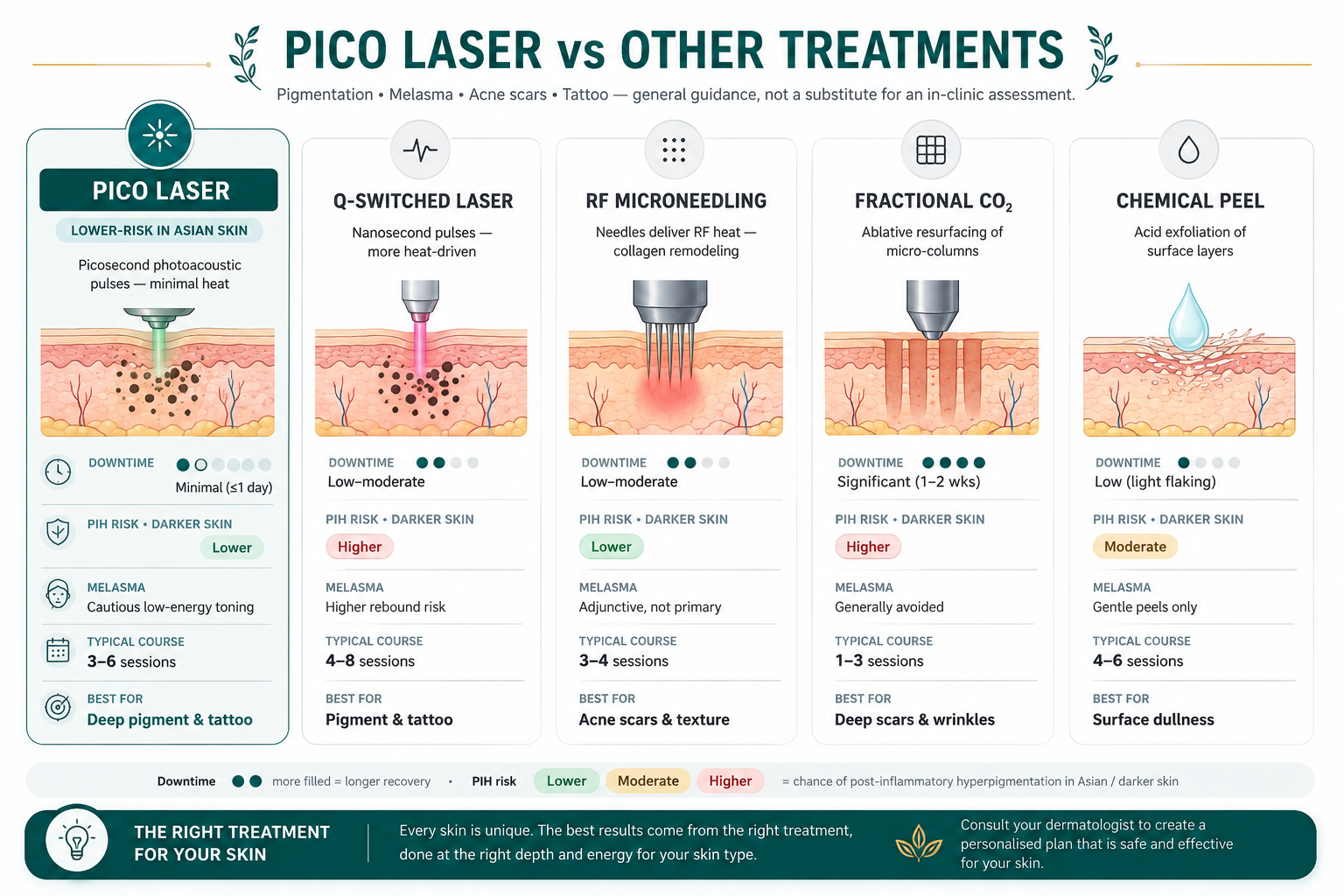
Pico Laser vs other treatments — text comparison
Comparison of Pico laser, Q-switched laser, RF microneedling, fractional CO2 and chemical peel for pigmentation, melasma, acne scars and tattoo removal, at Loh & Celine Skin Specialist Clinic, Alor Setar, Kedah.
Pico Laser vs other treatments comparison
Treatment
How it works
Downtime
PIH risk in Asian / darker skin
Melasma
Typical sessions
Best for
Pico Laser
Picosecond photoacoustic pulses, minimal heat
Minimal (up to 1 day)
Lower
Used cautiously in low-energy toning
3–6
Deep pigment and tattoo removal
Q-Switched Laser
Nanosecond pulses, more heat-driven
Low to moderate
Higher
Higher risk of relapse or rebound
4–8
Pigment and tattoo removal
RF Microneedling
Needles deliver radiofrequency heat to remodel collagen
Low to moderate
Lower
Adjunctive, not a primary pigment tool
3–4
Acne scars and texture
Fractional CO2
Ablative resurfacing of micro-columns
Significant (1–2 weeks)
Higher
Generally avoided
1–3
Deeper acne scars and wrinkles
Chemical Peel
Acid exfoliation of surface layers
Low (light flaking)
Moderate
Gentle, conservative peels only
4–6
Surface dullness and mild pigment
Before & After — Pico Laser (2 of 5)Before & After — Pico Laser (3 of 5)Before & After — Pico Laser (4 of 5)Before & After — Pico Laser (5 of 5)
Pico laser delivers energy in picosecond pulses — trillionths of a second — to shatter pigment particles and stimulate skin repair while causing very little heat damage to surrounding tissue.
The name comes from the pulse duration. A picosecond is one-trillionth of a second (10⁻¹²). Older “Q-switched” lasers fire in nanoseconds — about a thousand times longer. That difference in speed changes how the laser interacts with skin.
Picosecond versus nanosecond lasers
Nanosecond (Q-switched) lasers heat pigment to break it down, transferring more warmth to nearby skin.
Picosecond lasers deliver energy so fast they create a rapid pressure wave that fragments pigment into finer particles, with less surrounding heat.
The photoacoustic effect
Because the pulse is faster than the time heat needs to spread (thermal relaxation time), pigment absorbs energy as a shockwave rather than sustained heat. This “photoacoustic” action breaks pigment into smaller fragments the body’s immune cells can clear more easily.
Minimal thermal injury
Less heat means, in appropriately selected patients, a lower risk of certain heat-related side effects. This matters for Asian and darker skin, where excess heat can trigger post-inflammatory hyperpigmentation (PIH). “Minimal” does not mean “zero”, so settings must still be individualised.
Laser-Induced Optical Breakdown (LIOB)
At higher energy densities, pico lasers can produce Laser-Induced Optical Breakdown — tiny controlled zones creating microscopic cavitation bubbles. This triggers a wound-healing response and collagen remodelling without significant surface damage, the basis of pico laser’s rejuvenation and mild scar-improvement effects.
In one line: Pico laser uses ultra-fast pulses to break pigment mechanically and gently stimulate collagen, aiming for results with less heat than older lasers.
How Pico Laser Works
Pico laser works in two main ways: it fragments unwanted pigment so the body can clear it, and it stimulates collagen to improve skin texture.
⚡ Pigment breakdown
Melanin or tattoo ink absorbs the laser’s light. The picosecond pulse fragments the particles, and the body’s macrophages gradually clear them over weeks — which is why results appear progressively and sessions are spaced apart.
✨ Collagen stimulation
Through the LIOB effect and controlled dermal stimulation, pico laser encourages new collagen and elastin, softening fine lines, refining texture and improving the look of some shallow scars.
Different wavelengths
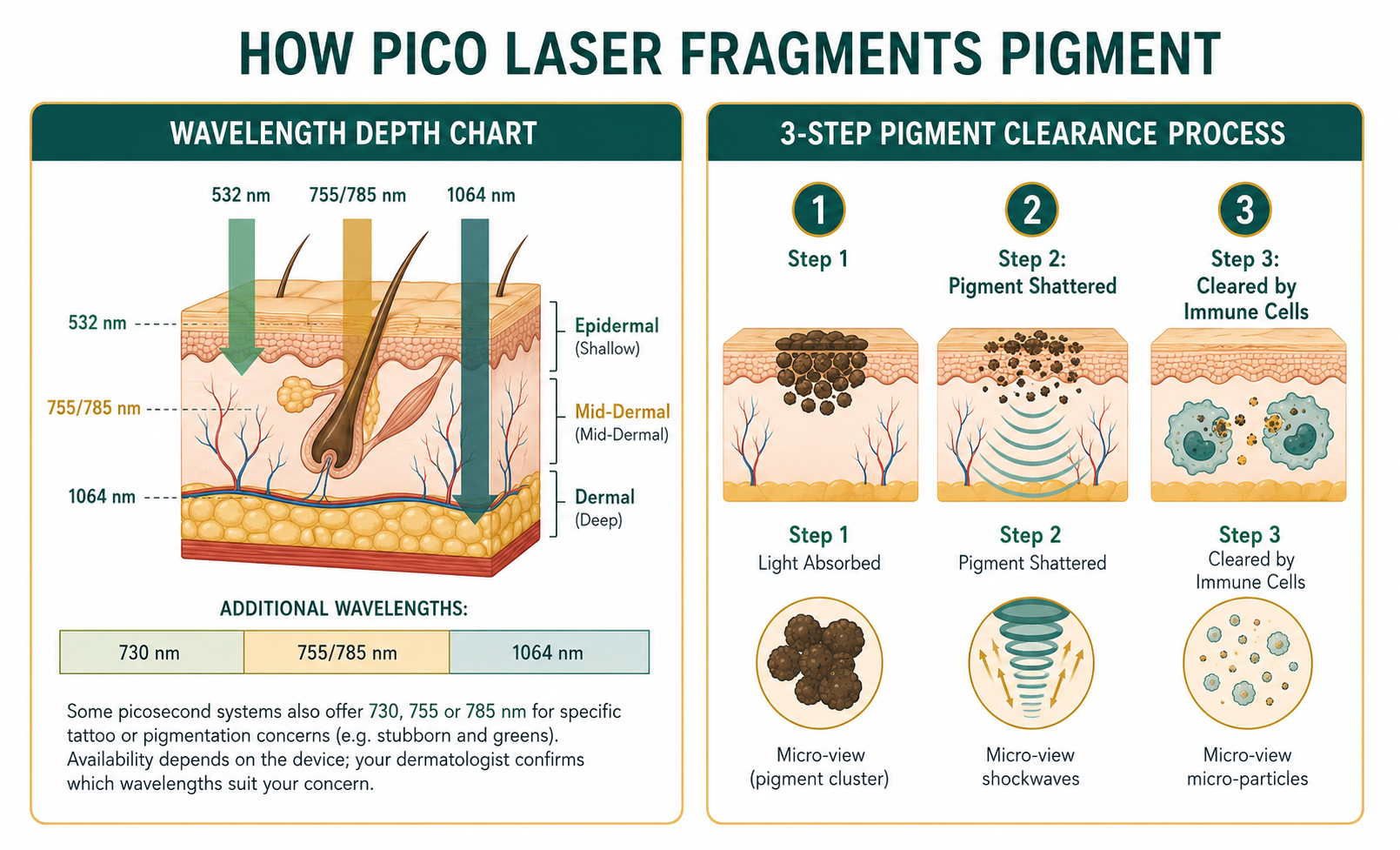
Wavelength determines how deep the laser reaches and which pigment it targets. Loh & Celine Skin Specialist Clinic uses a picosecond Nd:YAG platform delivering 532 nm and 1064 nm:
Wavelength
Typical target
Depth
532 nm
Superficial pigment — freckles, sun spots, red/orange tattoo ink
Some picosecond systems also offer 730, 755 or 785 nm for specific tattoo colours (e.g. stubborn blues and greens). Availability depends on the device; your dermatologist confirms which wavelengths suit your concern.
How pico laser works in Malaysia: the 532 nm, 755/785 nm and 1064 nm wavelengths target pigment at different skin depths, then each ultra-short picosecond pulse shatters the pigment into fine particles the body's immune cells clear over three steps — pico laser treatment at Loh & Celine Skin Specialist Clinic, Alor Setar, Kedah.
Spot sizes and pulse duration
Spot size affects how deeply and intensely energy is delivered; larger spots generally penetrate deeper.
Pulse duration in the picosecond range gives the photoacoustic advantage.
A fractionated (diffractive) handpiece spreads energy into microscopic zones for texture and rejuvenation rather than bulk pigment removal.
Why dermatologist settings matter: there is no universal “pico setting”. Wavelength, spot size, energy and passes must match your diagnosis, skin type and prior response. The same device set too aggressively on melasma can make it worse.
Conditions Treated
Pico laser can help with a range of concerns, but the degree of benefit varies enormously by condition. Explore each below.
🌞Melasma
What it is
A chronic pigmentation on cheeks, forehead and upper lip, driven by hormones, sun and heat; common in Asian women. Dalam bahasa Melayu, ia sering dikaitkan dengan jeragat hormon.
Why pico helps
Low-energy “toning” can gently lighten it in some patients.
Results & limits
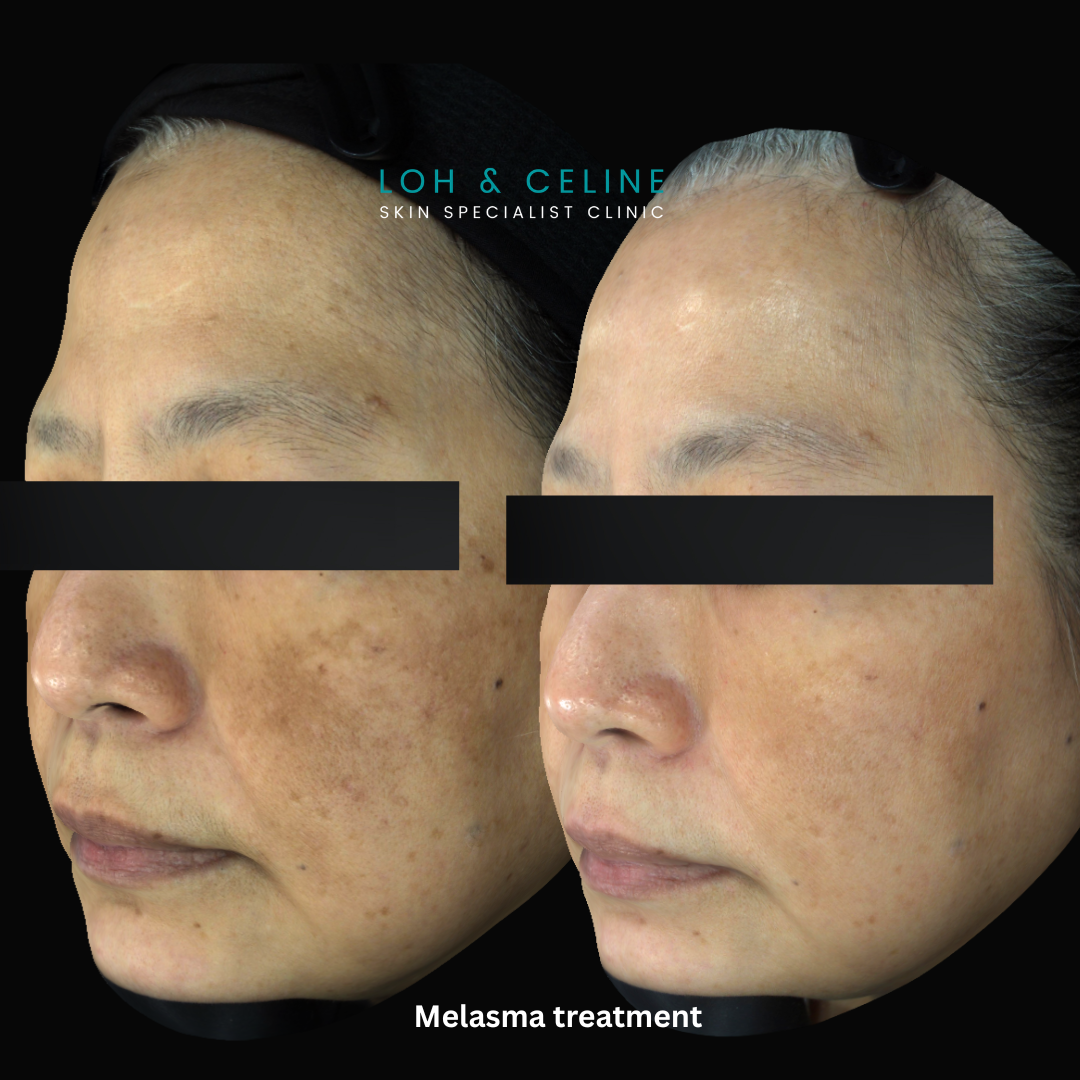
Gradual, partial lightening; managed, not cured. Prone to relapse and can worsen with aggressive laser.
Combination
Usually combined with topicals, sun protection, sometimes peels.
Congenital or acquired blue-grey dermal pigmentation, usually around one eye and cheek. Sejenis tanda lahir pigmentasi dalam (dermal) berwarna kelabu-biru.
Why pico helps
1064 nm reaches this deep pigment effectively.
Results & limits
Often significant clearance over a series; recurrence possible.
Medically reviewed & written by Dr Loh Ken Chen, Consultant Dermatologist — Loh & Celine Skin Specialist Clinic. This section on conditions treated (melasma, jeragat, jerawat, parut jerawat) is provided for patient education.
Who is a Good Candidate?
A good candidate has a correctly diagnosed, laser-responsive concern, realistic expectations, and no contraindications — confirmed at a dermatologist consultation.
✓ Generally suitable
Most skin types, including Asian skin, with appropriate conservative settings
Realistic expectations of gradual, partial improvement
Well-defined pigment, sun spots, freckles, dermal pigment or tattoos
Stable health, no active infection in the area
Committed to sun protection before and after treatment
Photosensitive disorders (e.g. lupus) or photosensitising medication
Recent isotretinoin — timing to be advised
Young children — only for specific medical indications
Who Should NOT Have Pico Laser?
Pico laser should be delayed or avoided for people with certain conditions, medications or circumstances.
🚫 Delay or avoid if you…
Are pregnant or breastfeeding (for elective indications)
Have an active skin infection or open wound in the area
Have had recent significant sun exposure, a suntan or sunburn
Have a photosensitive disease or take photosensitising medication
Have recently finished, or are on, oral isotretinoin (timing to be advised)
Have a history of keloid or abnormal scarring (needs careful assessment)
Expect complete, permanent clearance
Have an undiagnosed changing pigmented lesion — must be evaluated to exclude skin cancer before any cosmetic laser
Important: This list is general. Only an in-person dermatologist assessment can determine whether pico laser is safe and appropriate for you.
What Happens During Treatment?
The pico laser journey moves from diagnosis to treatment to review — with assessment, not the laser itself, being the most important step.
Consultation
Your concerns, history, medications and expectations are discussed.
Diagnosis
Examination (dermatoscope / Wood’s lamp) identifies the exact condition — e.g. melasma vs Hori’s nevus.
Photography
Standardised photos document your baseline for objective tracking.
Preparation
Skin cleansed; numbing cream may be applied; protective eyewear provided.
Treatment
The laser passes over the area — often like tiny rubber-band snaps. A few minutes up to ~30.
Cooling
Cooling and soothing measures calm the skin.
Aftercare
Instructions on sun protection, moisturising and what to avoid. Sunscreen is essential.
Review
Follow-ups assess response and fine-tune settings for the next session.
Recovery Timeline
Downtime after pico laser is usually short, but varies with treatment intensity and the condition treated.
0Immediately: Mild redness, warmth, sometimes slight swelling; treated pigment may look darker or “frosted”.
1d24 hours: Redness settles; makeup may be permitted depending on area — follow clinic advice.
3d3 days: Tiny scabs or darkened pigment begin to flake; skin feels more normal.
1w1 week: Most visible recovery complete; pigment continues clearing internally.
1m1 month: Fuller results appear as pigment clears and collagen remodels; next session may be scheduled.
Timelines are approximate. Rejuvenation “toning” often has minimal downtime; intensive pigment or tattoo treatments may involve a little more.
Before and After Results
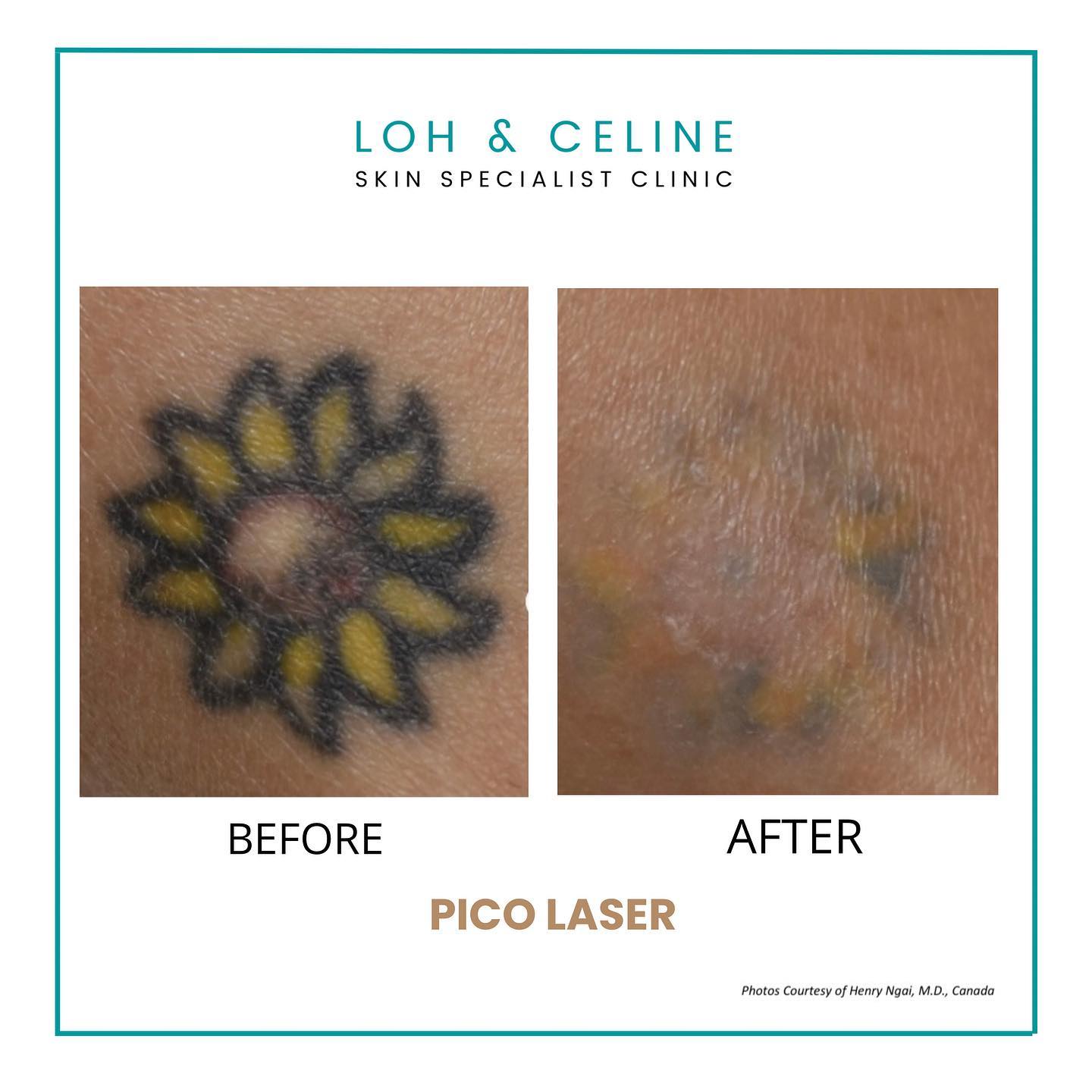
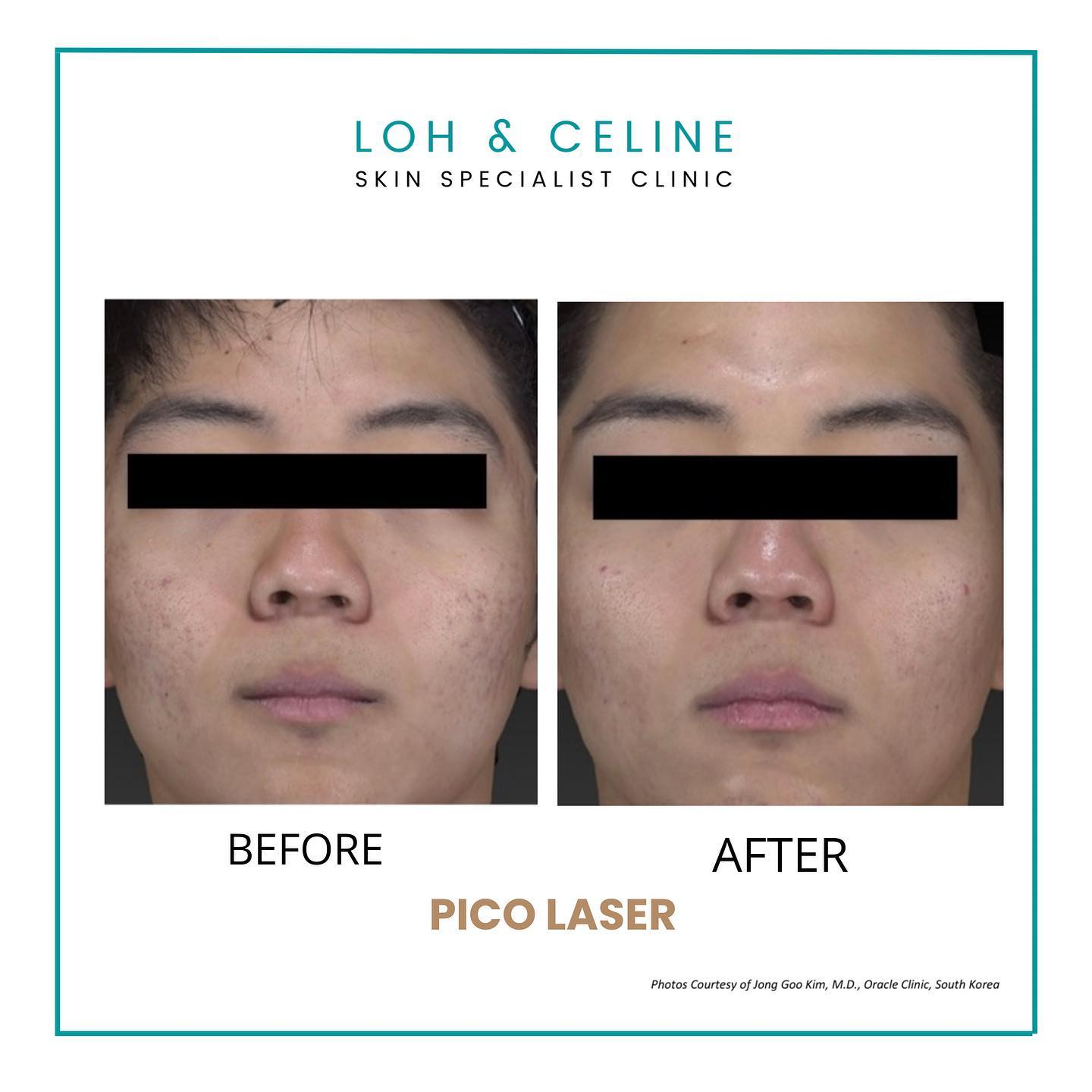
Realistic expectations are essential: pico laser produces gradual, cumulative improvement, and outcomes differ from person to person.
Results depend on the condition, its depth, your skin type, sun-protection habits and how many sessions you complete. Superficial pigment such as freckles and sun spots often responds well, while melasma and deep acne scarring typically show partial improvement and need ongoing management.
Real Patient Before & After Gallery
1 / 5
Before & After — Pico Laser (1 of 5)Before & After — Pico Laser (2 of 5)Before & After — Pico Laser (3 of 5)Before & After — Pico Laser (4 of 5)Before & After — Pico Laser (5 of 5)
📸Add More Before & After Cases Here
Recommended: 2–3 side-by-side pairs per condition with session count & timeframe captions. Alt text e.g. “pico laser melasma before after Kedah”.
Because every case is different, images illustrate what has been possible for particular patients rather than a guaranteed result for everyone. Your dermatologist will give a realistic estimate for your situation during consultation.
Benefits
Pico laser offers both medical and cosmetic benefits when used appropriately.
🩺Medical
• Effective fragmentation of many pigment types
• Reaches deep dermal pigment (Nevus of Ota, Hori’s nevus)
• Efficient tattoo-ink removal, often fewer sessions
✨Cosmetic
• Brighter, more even skin tone
• Refined texture; modest scar & pore improvement
• Collagen stimulation for a fresher look
⏱Practical
• Generally minimal downtime
• Suitable for Asian skin with proper assessment
• Integrates into a personalised plan
Risks and Side Effects
Pico laser is well tolerated in appropriately selected patients, but no laser is risk-free.
Possible side effects
Temporary redness — usually settles within hours to a day
Swelling — mild and short-lived
PIH — temporary darkening, more likely in darker skin or with aggressive settings
Hypopigmentation — usually temporary lightening
Blistering — uncommon; more likely with tattoo removal
Scarring — rare with careful, appropriate settings
How assessment reduces risk
Accurate diagnosis prevents treating the wrong condition
Conservative, skin-type-appropriate settings reduce PIH and burns
The operator’s medical expertise matters as much as the device.
Comparison Tables
These tables compare pico laser with other common treatments. The most suitable option always depends on your specific diagnosis.
Pico Laser vs Q-Switched Laser
Feature
Pico Laser
Q-Switched Laser
Mechanism
Picosecond, mainly photoacoustic
Nanosecond, more photothermal
Heat to skin
Lower
Higher
Downtime
Generally shorter
Can be longer
Sessions
Often fewer
Often more
Best indications
Pigment, tattoos, rejuvenation
Pigment, tattoos
Limitations
Cost; still needs correct diagnosis
More heat-related PIH risk
Pico Laser vs IPL
Feature
Pico Laser
IPL
Mechanism
Focused laser, photoacoustic
Broadband light, photothermal
Downtime
Short
Short
Sessions
Varies
Often several
Best indications
Defined pigment, dermal pigment, tattoos
Superficial pigment, redness, tone
Limitations
Not for vascular redness
Not ideal for deep pigment; heat risk in dark skin
Pico Laser vs Fractional CO₂
Feature
Pico Laser
Fractional CO₂
Mechanism
Photoacoustic + mild collagen
Ablative resurfacing
Downtime
Short
Longer (days of peeling/redness)
Sessions
Multiple, gentle
Fewer, more intensive
Best indications
Pigment, mild texture
Deeper scars, significant texture/wrinkles
Limitations
Limited for deep scars
More downtime; higher PIH risk in dark skin
Pico Laser vs Sylfirm X
Feature
Pico Laser
Sylfirm X (RF Microneedling)
Mechanism
Light-based pigment fragmentation
Radiofrequency + microneedling
Downtime
Short
Short to moderate
Sessions
Multiple
Multiple
Best indications
Pigment, tattoos, tone
Melasma, redness, texture, mild laxity
Limitations
Less effect on laxity
Less effective for tattoos/deep pigment
Pico Laser vs Chemical Peel
Feature
Pico Laser
Chemical Peel
Mechanism
Laser energy
Chemical exfoliation
Downtime
Short
Varies with peel depth
Sessions
Multiple
Multiple
Best indications
Defined + dermal pigment, tattoos
Superficial pigment, dullness, mild acne
Limitations
Cost
Limited for deep/dermal pigment
Pico Laser vs other treatments — how picosecond laser compares with Q-switched laser, RF microneedling, fractional CO₂ and chemical peel for pigmentation, melasma, acne scars and tattoo removal. The chart compares downtime, risk of post-inflammatory hyperpigmentation (PIH) in Asian and darker skin, and the typical number of sessions. General guidance only — the right treatment depends on an in-clinic dermatologist assessment at Loh & Celine Skin Specialist Clinic, Alor Setar, Kedah.
Takeaway: Pico laser offers lower pigmentation-rebound risk in Asian skin and minimal downtime — but deeper acne scars often respond best to combination therapy such as RF microneedling or fractional resurfacing, and melasma is a medical condition where accurate diagnosis matters more than the device.
Combination Treatments
Pico laser often works best as part of a combined, individualised plan rather than alone.
💉Sylfirm X
RF microneedling for melasma or texture alongside pigment.
🪥Topical medications
Pigment-regulating and barrier support, especially for melasma and PIH.
Regenerative skincare (where supported) to aid recovery and skin quality.
Every treatment plan is individualised. The right combination — and the right order of treatments — depends on your diagnosis, skin type and response over time.
Frequently Asked Questions
Does pico laser hurt?
Most patients tolerate it well, describing tiny rubber-band-like snaps or warmth. Numbing cream can be applied for comfort.
How many sessions will I need?
Commonly 3–6, though some concerns clear sooner and others (deep pigment, tattoos, scars) need more. Your dermatologist estimates this after assessment.
How far apart are the sessions?
Typically a few weeks apart to let skin recover and clear fragmented pigment. Exact spacing depends on the condition.
Can melasma come back after pico laser?
Yes. Melasma is a chronic, relapsing condition. Laser can lighten it but does not cure it; ongoing sun protection and topicals are essential.
Can dark skin be treated safely?
Yes, with appropriate, conservative settings. Darker skin has a higher PIH risk, so dermatologist supervision is especially important.
Can I wear makeup afterwards?
Often after about 24 hours, depending on the area and intensity. Follow your clinic’s specific aftercare advice.
Can I exercise after treatment?
Strenuous exercise and heavy sweating are best avoided for a short period, as heat and sweat can irritate freshly treated skin.
How long do results last?
It depends on the condition. Sun spots and freckles can stay clear with good sun protection, but new pigment may form with UV exposure; melasma tends to recur without maintenance.
How much downtime is there?
Usually minimal — often just mild redness for hours to a day. More intensive treatments such as tattoo removal may involve slightly more.
Can pico laser remove tattoos completely?
Many tattoos fade substantially, and black ink responds best. Complete removal is not guaranteed, and some colours are stubborn.
Can pico laser remove birthmarks?
Some pigmented birthmarks respond, others recur, and not all are suitable. Assessment is essential, as certain lesions need monitoring instead.
Can pico laser worsen pigmentation?
It can if the wrong condition is treated or settings are too aggressive — particularly with melasma. Correct diagnosis and conservative settings reduce this risk.
Is pico laser safe?
In appropriately selected patients treated by a trained professional, it is generally safe. No laser is risk-free, which is why assessment matters.
How much does pico laser cost in Malaysia?
Cost varies with the condition, area treated and number of sessions. You will receive a personalised estimate at consultation rather than a fixed price online.
How should I prepare for treatment?
Avoid sun exposure and tanning beforehand, disclose medications, and follow any pre-treatment instructions from your dermatologist.
What should I do after treatment?
Protect the area from sun, use sunscreen diligently, keep skin moisturised, and avoid picking at any flaking pigment.
When will I see results?
Some brightening may appear within days, but fuller results emerge over weeks as pigment clears and, over several sessions, cumulatively.
Is pico laser better than Q-switched laser?
Pico often works faster with less heat, but the most suitable choice depends on the condition. Your dermatologist selects the right device for your case.
Can pico laser treat acne scars?
It can soften shallow scars and improve texture via collagen stimulation, but deep scars usually need combination treatment.
Can pico laser treat active acne?
It is not a primary acne treatment. Active acne should be controlled first; pico may then help residual marks.
Is there any age limit?
No strict limit, but treatment is individualised and generally avoided in young children except for specific medical reasons.
Can I have pico laser while pregnant?
Elective laser is generally postponed during pregnancy and breastfeeding as a precaution.
Will I need maintenance sessions?
For relapsing conditions like melasma, periodic maintenance and daily sun protection help sustain results.
Does pico laser tighten skin?
It mainly targets pigment and mild texture. Significant laxity is better addressed with dedicated tightening treatments.
Can pico laser remove freckles permanently?
Existing freckles can fade well, but new ones may form with future sun exposure, so results are not strictly permanent.
Is pico laser suitable for sensitive skin?
Often yes, with conservative settings, but sensitive or reactive skin should be assessed carefully first.
How do I know if I have melasma or Hori’s nevus?
They look similar but differ in depth and treatment. A dermatologist can distinguish them using examination tools — getting this right is crucial.
Can pico laser help with large pores?
It can modestly refine pore appearance through collagen stimulation, but pores are not eliminated.
Is downtime different for tattoo removal?
Yes — tattoo removal uses higher energy and may involve more redness, temporary whitening or occasional blistering.
What are the signs I should NOT proceed?
Active infection, recent sunburn/tan, pregnancy (for elective treatment), or an undiagnosed changing lesion — all should be reviewed first.
Why should a dermatologist perform pico laser?
Because diagnosis drives the settings. A dermatologist can identify the exact condition, exclude skin cancer, and tailor safe, effective parameters.
How do I book a consultation?
You can contact the clinic in Alor Setar to arrange a personalised skin assessment before any treatment begins.
Why Choose a Dermatologist?
With pico laser, the diagnosis and the settings matter more than the machine — and both depend on medical expertise.
🔍Diagnosis matters
Pigment disorders that look alike (e.g. melasma vs Hori’s nevus) need very different approaches.
⚙Individualised settings
Wavelength, energy and spot size are matched to your skin type and response over time.
⚠Avoiding harm
Treating melasma as a simple sun spot can aggravate it; correct diagnosis prevents this.
🛡Safety net
A dermatologist can also exclude serious conditions such as skin cancer before any cosmetic laser.
Meet Our Dermatologists
At Loh & Celine Skin Specialist Clinic, treatment begins with assessment by a board-certified dermatologist. Our approach is built on evidence-based care, accurate diagnosis and personalised treatment planning — so pico laser (and any combination therapy) is recommended only when it is genuinely appropriate for your skin.
Patients from Alor Setar, Sungai Petani, and across Kedah, Penang and Perlis are seen with the same principle: understand the condition first, then choose the safest, most effective plan for realistic, lasting results.
Dr Loh diagnoses and treats medical skin, hair and nail conditions — including acne, eczema, psoriasis, pigmentary disorders and more — with evidence-based, personalised care.
Pico laser is not automatically suitable for everyone — the right plan starts with an accurate diagnosis. Book a consultation with our dermatology team in Alor Setar for a personalised assessment of your pigmentation, melasma, acne scars or rejuvenation goals.
This article is for general education and does not replace individual medical advice. Treatment suitability, results and risks vary between patients and can only be determined through an in-person dermatologist consultation.