
Laser for Acne Scars in Malaysia: A Dermatologist's Guide to Fractional CO₂ Laser
Acne scars are not all the same — and the laser is never the first decision. This is a clinician's guide to how fractional CO₂ laser genuinely improves selected atrophic acne scars, which scar types respond, where its limits lie, and how we treat Asian skin safely. At Loh & Celine Skin Specialist Clinic in Alor Setar, Kedah, fractional CO₂ is one carefully chosen tool within an individualised plan — not a one-size-fits-all fix.
Book a Dermatologist ConsultationDoes laser work for acne scars?
Quick answer
Yes — for the right scars. Fractional CO₂ laser can meaningfully improve many atrophic (depressed) acne scars, especially surface textural irregularity and superficial-to-moderate boxcar scars. It works by creating controlled microscopic zones of resurfacing that trigger wound healing and new collagen. But it does not erase scars, and it is not the right stand-alone choice for every scar type or every patient.
Here is the honest, clinical summary before the detail:
- Fractional CO₂ improves selected atrophic acne scars through fractional resurfacing and collagen remodelling.
- Results depend strongly on scar type and depth — a shallow boxcar scar and a deep ice-pick scar do not behave the same way.
- It reduces the appearance of scars; it does not literally remove scar tissue.
- Deep ice-pick scars and strongly tethered rolling scars often need additional or combination procedures (for example TCA CROSS or subcision).
- In Asian and darker skin, careful patient selection, conservative parameters and diligent aftercare are essential to reduce the risk of post-inflammatory hyperpigmentation (PIH).
What is fractional CO₂ laser?
Fractional CO₂ laser is an ablative fractional resurfacing treatment. Two words do most of the work in that sentence — “ablative” and “fractional” — so it helps to understand both.
Ablative means the laser removes (vaporises) very thin, precise columns of skin tissue, rather than only heating it from underneath. The carbon dioxide laser's wavelength (10,600 nm) is strongly absorbed by water in the skin, which is what allows it to resurface tissue in a controlled way. Ablative lasers generally produce stronger resurfacing — and more downtime — than non-ablative lasers, which heat the deeper skin while leaving the surface intact.
Fractional means the laser energy is delivered as a grid of thousands of tiny microscopic beams rather than as one continuous sheet. Each beam creates a narrow microthermal treatment zone (MTZ) — a column of controlled injury — while the skin immediately around each column is left untouched. That surrounding healthy tissue acts as a reservoir of cells that speeds healing, which is why fractional resurfacing is safer and recovers faster than the older, fully-ablative “full-field” CO₂ resurfacing of the past.
At our clinic we use an Edge Fractional CO₂ laser, a current-generation fractional CO₂ system. Newer fractional CO₂ platforms are designed to produce very fine treatment columns, which can help reduce the intensity and duration of redness and crusting compared with older CO₂ lasers. The underlying principle, however, is the same across quality fractional CO₂ devices: controlled fractional injury that stimulates the skin's own repair and remodelling.
How does fractional CO₂ improve acne scars?
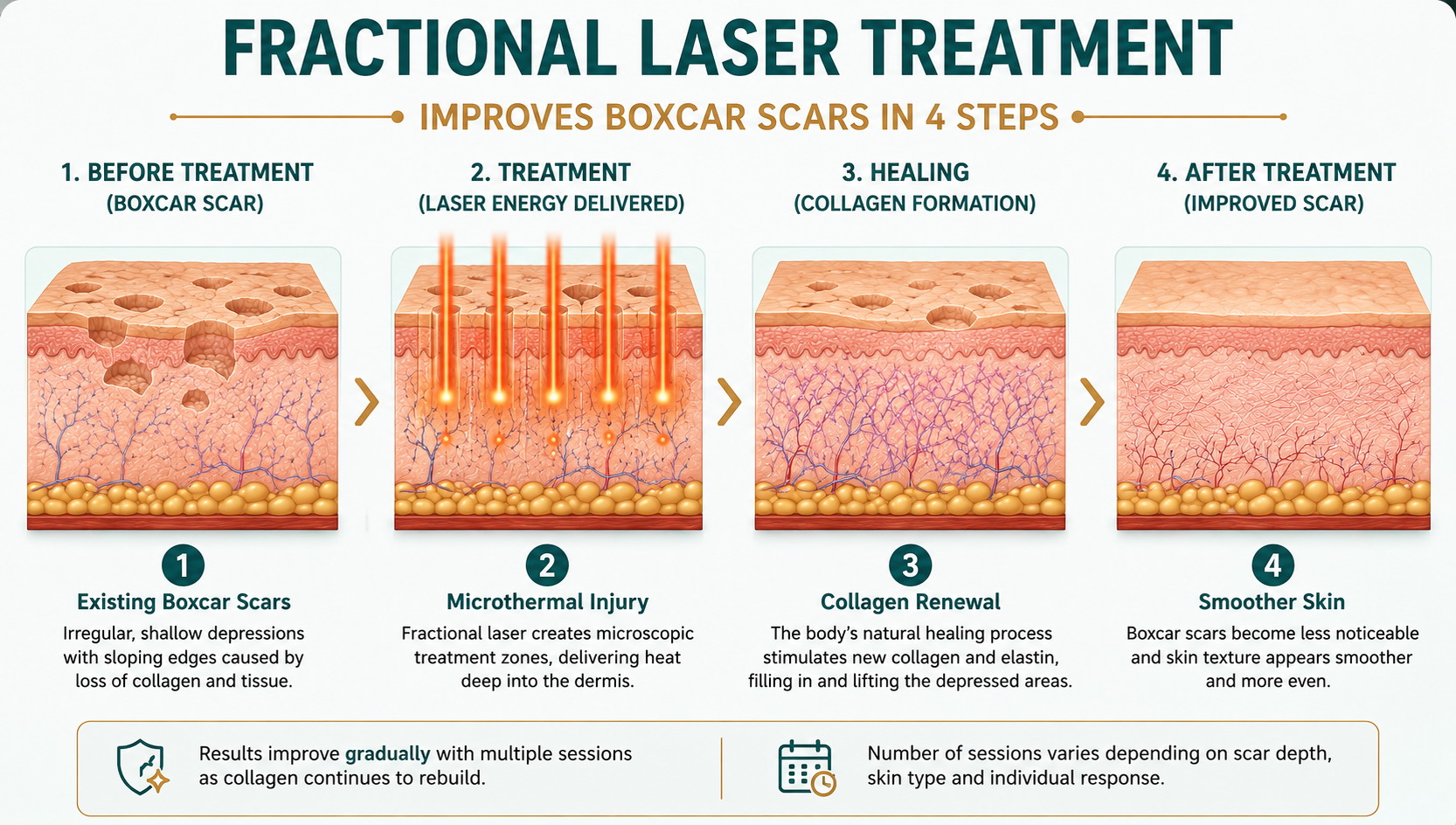
Atrophic acne scars are, in simple terms, areas where the skin lost collagen during acne healing and became depressed. Fractional CO₂ laser works by prompting the skin to rebuild in those areas. The mechanism, step by step:
- Controlled micro-injury. The fractional laser creates thousands of microscopic columns of thermal injury (MTZs) into the epidermis and dermis, surrounded by untouched skin.
- Wound-healing response. Each column triggers the skin's natural wound-healing cascade — clearing damaged tissue and recruiting repair cells.
- Fibroblast activity & matrix remodelling. Fibroblasts become active and reorganise the dermal extracellular matrix around the scar.
- New collagen formation. Over the following weeks, new collagen is laid down and the tissue remodels, which can gradually lift and soften depressed scars.
- Progressive textural improvement. Across the healing and remodelling period, the surface irregularity of selected atrophic scars can become less pronounced.
This is why the honest language is improve, soften, remodel, reduce the appearance — not erase, cure or permanently remove. Collagen remodelling is a biological process that unfolds over weeks to months; it is a genuine change in the skin, but it is a gradual improvement of scarred tissue rather than a deletion of it.
Not all acne scars are the same
This is the single most important section on the page. “Acne scars” is not one diagnosis — it is a family of different scar shapes that behave very differently and respond to very different treatments. Getting this classification right is what separates a good result from a disappointing one.
Most acne scars fall into three atrophic (depressed) patterns, plus a separate raised category. Dermatology literature commonly describes them like this:
Rolling scars
Rolling scars are the widest — often up to about 4–5 mm across — with sloping, indistinct edges that give the skin an undulating, “rolling” appearance. Their defining feature is tethering: fibrous bands anchor the skin surface down to the deeper tissue, casting a shadow that reads as a dip.
Fractional CO₂ can improve the surface texture of rolling scars, but resurfacing alone may not fully release the deeper tethering that causes the depression. In selected tethered rolling scars, subcision — a technique that releases those fibrous bands from underneath — may be considered, often in combination with resurfacing rather than instead of it.
Boxcar scars
Boxcar scars are round-to-oval depressions, roughly 1.5–4 mm wide, with sharply defined vertical walls — like a small crater with a flat base. They are usually divided into:
- Superficial boxcar (shallower): often responds well to fractional resurfacing.
- Deep boxcar (steeper, deeper walls): may improve with resurfacing but frequently benefits from a combination approach.
This is where fractional CO₂ tends to perform at its best. The controlled resurfacing can soften the sharp edges and stimulate collagen at the base, making the crater shallower and less shadowed over time.
Ice-pick scars
Ice-pick scars are narrow (typically under 2 mm), deep and V-shaped, tapering to a fine point deep in the dermis — like a puncture. Because they are so deep and focal, they are notoriously resistant to surface resurfacing. Fractional CO₂ across the surface often cannot reach the base of a true ice-pick scar.
For many ice-pick scars, a more targeted technique such as TCA CROSS (chemical reconstruction of skin scars, in which a high-strength acid is applied precisely to the scar base to stimulate collagen from within) is frequently more appropriate — sometimes alongside fractional CO₂ used to refine the surrounding texture.
Hypertrophic (raised) acne scars
Not all acne scars are depressed. Hypertrophic and keloidal scars are raised — the opposite problem — caused by excess collagen. It is important to distinguish these clearly, because fractional CO₂ resurfacing is not automatically the right treatment for raised scars, and some ablative approaches on keloid-prone skin need particular caution. Raised acne scars are usually managed through a different pathway.
Which acne scars respond best to CO₂ laser?
No responsible clinician can promise a fixed outcome, because response depends on depth, tethering, skin type and treatment parameters. But as a general clinical guide:
| Scar type | Typical role of fractional CO₂ |
|---|---|
| Superficial boxcar | Often useful — a strong indication for resurfacing. |
| Moderate / deep boxcar | Potentially useful; deeper scars may need a combination approach. |
| Rolling scars | May improve surface texture; underlying tethering may need subcision as well. |
| Deep ice-pick | Often limited as a stand-alone treatment; TCA CROSS is frequently more targeted. |
| Mixed scars | Usually requires an individualised, staged plan combining more than one method. |
| Hypertrophic / keloid | Different treatment category — ablative resurfacing is not the default choice. |
This table describes general tendencies, not guarantees. Your own result depends on assessment findings and the settings chosen for your skin.
CO₂ laser vs Pico laser for acne scars
Which is better — CO₂ or Pico?
They solve different problems. Fractional CO₂ is primarily a resurfacing and collagen-remodelling treatment for atrophic textural scarring. Pico laser is primarily a pigment-management treatment — most useful when the main concern is dark marks rather than depressed texture. The right choice depends on what your skin's main problem actually is.
Patients often use “acne scars” to describe two quite different things:
- Textural scars — actual depressions in the skin (boxcar, rolling, ice-pick). These are a collagen problem, and this is fractional CO₂'s territory.
- Acne marks / post-acne pigmentation — flat brown or red marks left after a spot heals, with no change in skin texture. These are a pigment problem, and this is where Pico laser is often the more relevant tool.
Many people have both — genuine depressed scars and leftover pigmentation. In those cases the two treatments are complementary rather than competing, and the sequence and timing are decided at consultation. If your main concern is uneven pigmentation, dark marks or dullness with only mild texture change, our dermatologist guide to Pico laser explains that pathway in depth.
What about RF microneedling?
RF (radiofrequency) microneedling is another way to remodel acne scars. It delivers radiofrequency energy into the dermis through fine needles, stimulating collagen with a different injury profile from a laser — and often with less surface downtime, which can matter for some patients and some skin types. It is not, however, simply a like-for-like replacement for every resurfacing treatment; the two work differently and suit different situations.
Because RF microneedling deserves proper explanation in its own right, we keep it on a dedicated page rather than duplicating it here.
CO₂ laser for Asian skin & the PIH question
This is where experience with Malaysian and Asian skin genuinely changes the treatment. The honest position is not “CO₂ laser is completely safe for Asian skin” — it is that fractional CO₂ can be used successfully in Asian skin, but only with careful patient selection, appropriate settings and meticulous aftercare to reduce the risk of post-inflammatory hyperpigmentation (PIH).
Most Malaysian patients fall around Fitzpatrick skin types III–V. In these skin types, any inflammatory or ablative procedure carries a higher tendency for the skin to respond with temporary darkening (PIH) as it heals. This is the central safety consideration for CO₂ laser in our population — and it is very manageable, but it must be respected.
What the evidence actually shows
Published PIH rates after fractional CO₂ for acne scars vary widely between studies — which itself is the honest headline. Reported figures range from the low single digits in some series to the large majority of patients experiencing at least mild, temporary pigmentation in others. For example, across the literature on fractional resurfacing in darker skin, one CO₂ series reported PIH in roughly half of patients at one month with a much smaller proportion of residual pigmentation by six months, while another reported mild PIH in the great majority of participants; by contrast, fractional erbium and non-ablative devices have reported considerably lower rates in some studies.
The reason the numbers scatter so much is that PIH risk is not a fixed property of “CO₂ laser.” It depends on skin type, treatment density and energy, pre-treatment preparation, sun exposure and aftercare. That is precisely why parameters and patient selection matter more than the machine name. (Reported rates here are drawn from the dermatology literature and are given as ranges, not as a prediction for any individual patient — see references.)
How we lower the risk in practice
- Patient selection first — assessing skin type, pigmentation tendency and whether acne is currently controlled before recommending CO₂.
- Conservative, individualised settings — choosing density and energy appropriate to the skin type rather than the most aggressive possible pass.
- Skin preparation where appropriate — a pre-treatment regimen (for example a suitable pigment-controlling topical) may be advised for selected patients in the weeks before treatment.
- Strict sun protection — broad-spectrum sunscreen and sun avoidance before and after treatment, which is non-negotiable in the Malaysian climate.
- Structured aftercare — a clear post-treatment skincare and healing plan, with follow-up to catch and treat any early pigmentation promptly.
What happens during CO₂ laser treatment?
Understanding the journey removes most of the anxiety. A typical fractional CO₂ appointment for acne scars follows this shape:
- Consultation & scar assessment. Before anything else, your scar types, depth, tethering, pigmentation and current acne status are assessed, and the plan is agreed.
- Skin preparation. If appropriate for your skin, a preparatory regimen may have been started in the weeks beforehand.
- Cleansing. The treatment area is thoroughly cleansed.
- Topical anaesthesia. A numbing cream is usually applied and left for a period beforehand so the treatment is comfortable.
- Laser treatment. The fractional CO₂ laser is passed over the treatment area; the active laser time itself is generally short.
- Cooling & soothing. The skin is cooled and soothed immediately afterwards.
- Aftercare instructions. You are given a clear post-treatment plan for cleansing, moisturising, sun protection and what to expect while healing.
Exact numbing times and laser settings are decided individually and are not one-size-fits-all; your clinician will confirm the specifics for your treatment.
CO₂ laser recovery & downtime
How long is the downtime?
It varies with treatment intensity, area and skin type. After fractional CO₂ you can generally expect a period of redness, mild swelling, warmth and then light peeling or crusting as the skin resurfaces, followed by gradual settling. More intensive treatments mean more downtime; lighter treatments recover faster.
What most patients notice, in sequence:
- First hours to day one: warmth, redness and a sunburn-like sensation; some swelling, especially if larger areas are treated.
- Following days: the skin may feel rough and dry and go through light peeling or fine crusting as the treated columns heal. Newer fine-beam fractional CO₂ is designed to keep this milder and shorter than older CO₂ lasers.
- After the surface settles: a period of pinkness can remain, which fades over time and is easily covered once the skin has healed.
Because healing genuinely differs between people and between settings, we avoid quoting a single fixed “X days of downtime” for everyone. At your consultation we give you a realistic recovery window for your planned treatment and skin, and practical guidance on timing it around work or events.
How many CO₂ laser sessions are needed?
How many sessions will I need?
There is no universal number. Acne scar treatment is a course, not a single event, and the number of sessions depends on your scar severity, scar type, the treatment intensity used, your skin type and healing, your goals, and whether combination procedures are part of the plan.
Two people with “acne scars” can need quite different plans: a person with mild, mostly superficial texture may need relatively few sessions, while someone with deeper or mixed scarring may need a longer, staged course — sometimes alongside other techniques such as subcision or TCA CROSS for the scars that laser alone will not fully address.
Sessions are spaced apart to allow the skin to heal and collagen to remodel between treatments. Rather than promising a guaranteed number, we set out an expected range for your situation at consultation and reassess as your skin responds — because the right plan is the one that matches your scars, not a fixed package.
When will I see results?
Improvement from fractional CO₂ arrives in phases, and patience is part of the treatment:
- Early changes: once the initial redness and peeling settle, the skin often looks smoother and brighter as the surface renews.
- Healing phase: over the following weeks the treated skin continues to repair and even out.
- Collagen remodelling: the deeper improvement in scar depth comes from new collagen, which is laid down and remodelled over weeks to months — so scars typically continue to soften gradually after the surface has healed.
- Cumulative improvement: across a planned course, results build session on session.
This is why realistic expectations matter. Fractional CO₂ is not an “instant results” treatment; its main benefit is a progressive improvement in texture and scar depth that develops over time as collagen remodels.
Can CO₂ laser completely remove acne scars?
Can it remove scars completely?
No. Fractional CO₂ laser can improve the appearance of many acne scars — often substantially — but it does not literally erase scar tissue. The realistic goal is meaningful improvement: shallower, softer, less shadowed scars and smoother overall texture, not perfectly scar-free skin.
The degree of improvement depends on scar type, depth, your skin's characteristics, the treatment parameters and whether additional procedures are combined with the laser. A shallow boxcar scar may improve a great deal; a deep ice-pick scar treated with laser alone may change relatively little. Being clear about this up front is part of doing the treatment properly — and it is why our consultation focuses on what is realistically achievable for your scars.
When CO₂ laser may not be the best choice
Recommending against a treatment when it is not right is as important as offering it. Fractional CO₂ may not be the best first choice when:
- Scars are mainly deep ice-pick — where a targeted technique such as TCA CROSS is often more effective than surface resurfacing.
- Rolling scars are strongly tethered — where subcision to release the bands may be needed before, or instead of, relying on resurfacing.
- Acne is still active and inflamed — treating scars while acne is uncontrolled is usually premature; settling the acne comes first. If acne keeps flaring or is still leaving new scars, konsultasi dengan pakar dermatologi can help bring it under control first.
- There is significant uncontrolled pigmentation — which may need to be stabilised before adding an ablative treatment that can itself provoke pigmentation.
- Expectations are for complete removal — if the goal is perfectly scar-free skin, no laser can honestly deliver that.
- Aftercare cannot be followed — for example strict sun protection is not realistic for the person right now, which raises PIH risk.
- The skin or scar type makes ablative resurfacing inadvisable — including certain raised-scar or keloid-prone situations.
In these situations the answer is not “no treatment” — it is usually a different or combined approach. That might mean TCA CROSS, subcision, RF microneedling, pigment-focused treatment such as Pico laser, or first getting active acne under control — matched to what your skin actually needs.
Risks & side effects of CO₂ laser
Fractional CO₂ is a well-established treatment, but like any real medical procedure it has risks. Being open about them is part of informed consent. Possible side effects include:
- Redness and swelling — expected in the early healing period; usually settles.
- Prolonged erythema — redness that lasts longer than usual in some people.
- Post-inflammatory hyperpigmentation (PIH) — temporary darkening, the main consideration in Asian and darker skin (see above).
- Hypopigmentation — lightening of the skin, which is less common but can be longer-lasting.
- Infection — uncommon with proper aftercare, but possible any time the skin barrier is treated.
- Acne or milia flare — a temporary breakout or small bumps during healing in some patients.
- Prolonged healing — slower recovery in some individuals.
- Scarring — uncommon, but a recognised risk with any ablative resurfacing.
The likelihood of these depends heavily on patient factors and treatment parameters — which is exactly why assessment, appropriate settings and good aftercare matter. We will not tell you a procedure is “100% safe” or “zero risk,” because that is not true of any real treatment; we will tell you the actual risks and how we work to minimise them for your skin.
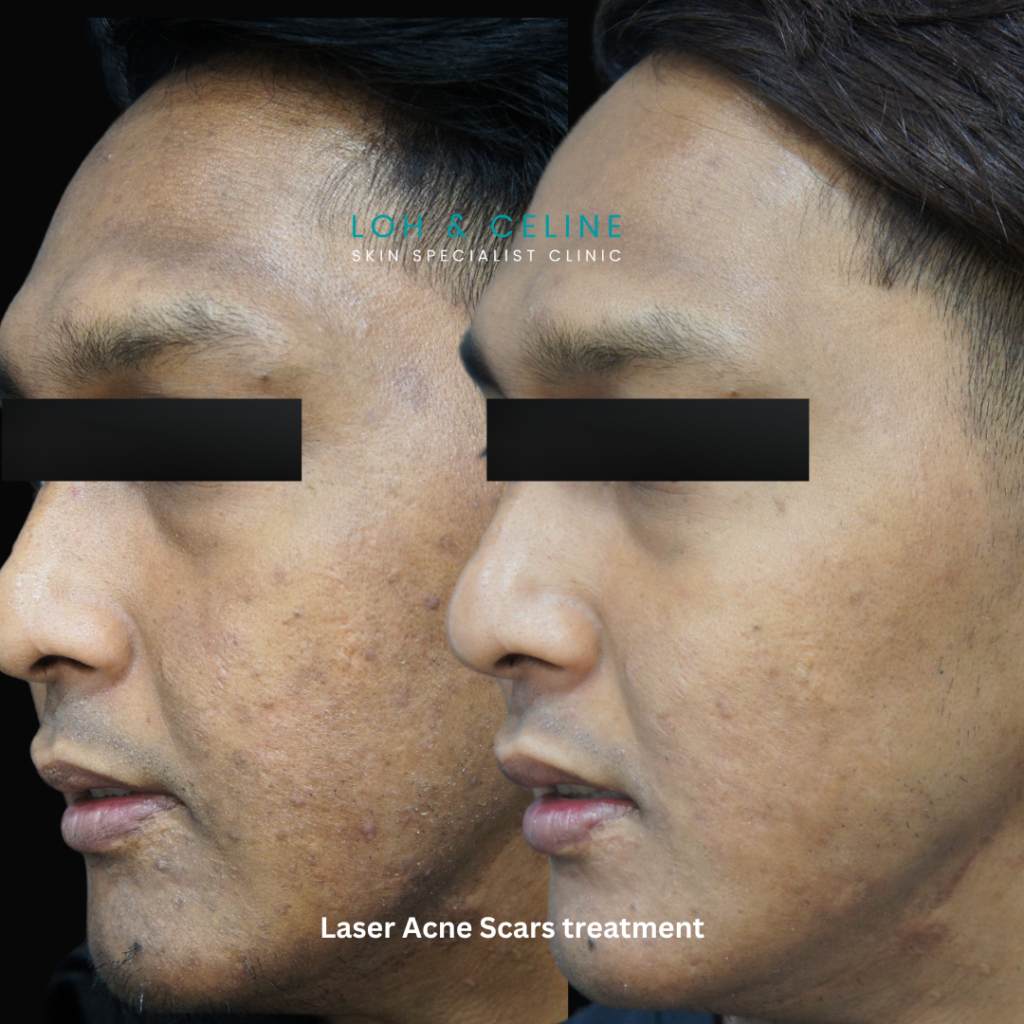
CO₂ laser before & after
These are real patients treated at Loh & Celine Skin Specialist Clinic. Results vary from person to person depending on scar type, skin and the plan followed — the images below are examples, not a promise of the same outcome for everyone.

Before/after disclaimer: Photographs show individual results and are not a guarantee of outcome. Results depend on scar type, skin type, number of sessions and adherence to aftercare. Images are unretouched and taken under consistent conditions where possible.
Dr Celine's approach: I assess the scar first, not the laser
When someone comes in asking for “CO₂ laser for acne scars,” my first job is not to book the laser — it is to understand the scars. Two faces that both look “scarred” can need completely different plans, and choosing a machine before understanding the scar is how patients end up disappointed.
So a consultation with me is really a scar assessment. I look at:
- Scar morphology — are these boxcar, rolling, ice-pick, mixed, or actually flat pigment marks rather than true scars?
- Depth and tethering — how deep are they, and are any rolling scars anchored down by fibrous bands?
- Pigmentation — is there post-acne pigmentation that needs its own plan, and what is the PIH risk for this skin?
- Active acne — is acne still inflamed? If so, we settle that before resurfacing.
- Skin type — Fitzpatrick type guides how conservative the settings need to be.
- Downtime tolerance — what recovery is realistic for this person's life and schedule.
- Previous procedures — what has already been tried, and how the skin responded.
- Expectations — what “better” means to this patient, and whether it is achievable.
Only after that do I decide whether fractional CO₂ is the right tool — and for many patients with atrophic, textural scarring, it is an excellent one. For others, the honest answer is that CO₂ should be combined with TCA CROSS or subcision, or that a pigment-focused or RF-microneedling approach fits better, or that we should treat their acne first. That reasoning — matching the treatment to the scar rather than the scar to a machine — is the whole point.
CO₂ laser vs other acne scar options at a glance
Fractional CO₂ is the hero treatment for atrophic textural scarring, but it sits within a small toolkit. Here is how the main options compare — and why they are often used together rather than in isolation:
| Treatment | Main role | Most useful for | Main limitation | Downtime |
|---|---|---|---|---|
| Fractional CO₂ laser | Ablative resurfacing + collagen remodelling | Boxcar & textural atrophic scars; overall surface irregularity | Limited for deep ice-pick; PIH care needed in darker skin | Moderate (redness, peeling) |
| Pico laser | Pigment breakdown + mild remodelling | Post-acne pigmentation & flat dark/red marks | Not a resurfacing treatment for deep texture | Minimal |
| TCA CROSS | Focal chemical rebuilding of the scar base | Ice-pick & narrow deep boxcar scars | Targeted spot treatment; needs several sessions; pigment care | Localised crusting |
| RF microneedling | Radiofrequency collagen remodelling | Textural scars where lower surface downtime is a priority | Different injury profile; not identical to laser resurfacing | Low–moderate |
| Subcision | Releasing fibrous tethering bands | Tethered rolling scars | Addresses tethering, not surface texture on its own | Bruising possible |
This is a decision aid, not a substitute for assessment. Most real plans combine two or more of these, sequenced to the individual.
Frequently asked questions
Does CO₂ laser work for acne scars?
Yes, for selected scars. Fractional CO₂ laser can improve many atrophic (depressed) acne scars, particularly textural irregularity and superficial-to-moderate boxcar scars, by resurfacing the skin and stimulating new collagen. Deep ice-pick scars and strongly tethered rolling scars may respond incompletely to laser alone and often need additional techniques.
Is CO₂ laser good for pitted acne scars?
Often yes. “Pitted” scars are usually boxcar or rolling depressions, and fractional CO₂ can soften their edges and lift their base over a course of treatment. How much improvement is possible depends on how deep the pits are and whether they are tethered.
Is CO₂ laser good for boxcar scars?
Boxcar scars are one of the best indications for fractional CO₂. Superficial boxcar scars often respond well; deeper boxcar scars can also improve but may benefit from a combination approach for the steepest walls.
Can CO₂ laser treat rolling scars?
Partly. CO₂ can improve the surface texture of rolling scars, but the depression is often caused by fibrous tethering under the skin, which resurfacing does not fully release. Tethered rolling scars may need subcision alongside the laser.
Can CO₂ laser treat ice-pick scars?
Ice-pick scars are the hardest for surface resurfacing because they are narrow and very deep. CO₂ alone is often limited here. TCA CROSS, which treats the scar base directly, is frequently a more effective option for ice-pick scars, sometimes combined with laser for the surrounding skin.
Is CO₂ laser better than Pico laser for acne scars?
Neither is universally “better” — they treat different problems. CO₂ is for depressed textural scarring; Pico is mainly for pigmentation and flat acne marks. If you have both, they can be used together.
How many CO₂ laser sessions are needed?
There is no universal number. It depends on scar severity and type, treatment intensity, your skin type and healing, your goals, and whether other procedures are combined. A realistic range is set at consultation and reassessed as your skin responds — beware fixed “guaranteed” session counts quoted before assessment.
How long is CO₂ laser downtime?
It varies with treatment intensity, area and skin type. Expect redness, mild swelling and light peeling or crusting as the skin heals, followed by a period of pinkness that fades. Lighter treatments recover faster; we give you a realistic window for your specific plan.
When will I see results?
Skin often looks smoother once early redness and peeling settle, but the deeper scar-depth improvement comes from collagen remodelling over weeks to months. Results build gradually across a treatment course rather than appearing instantly.
Can CO₂ laser completely remove acne scars?
No. It can improve the appearance of many acne scars — sometimes considerably — but it does not erase scar tissue. The realistic goal is shallower, softer, less visible scars and smoother texture, not perfectly scar-free skin.
Is CO₂ laser safe for Asian skin?
It can be used successfully in Asian skin, but not without care. The main consideration is post-inflammatory hyperpigmentation (PIH). Safe use relies on careful patient selection, conservative skin-appropriate settings, skin preparation where appropriate, strict sun protection and good aftercare — not on assuming it is “completely safe.”
Can CO₂ laser cause pigmentation?
Yes — temporary darkening (PIH) is the most relevant side effect in Asian and darker skin, because any ablative or inflammatory procedure can trigger it during healing. It is usually mild and temporary when the treatment is planned appropriately, but it is a real risk we manage deliberately.
What is the risk of PIH?
Published PIH rates after fractional CO₂ vary widely — from low single digits to the majority of patients in some series — because the risk depends on skin type, treatment density and energy, sun exposure and aftercare rather than being a fixed number. That variability is exactly why individualised settings and preparation matter. We assess your personal risk at consultation.
Can I have CO₂ laser if I still have acne?
Usually not while acne is active and inflamed. Treating scars over uncontrolled acne is premature and can complicate healing. Getting your acne under control first is part of the plan, and often improves the final scar result too.
Is fractional CO₂ painful?
A numbing cream is normally applied beforehand to keep the treatment comfortable. Many patients describe a warm, prickling sensation during the laser and some warmth afterwards. Comfort measures are part of the standard process.
Can I return to work after CO₂ laser?
It depends on how intensive the treatment was and how visible your redness or peeling is. Some people plan lighter treatments around their schedule; others prefer a few quieter days. We help you time treatment around work and events at consultation.
Is CO₂ laser suitable for deep acne scars?
For deep scars, CO₂ alone is often not enough. Deep ice-pick and deep boxcar or strongly tethered scars usually respond better to a combination — for example TCA CROSS or subcision alongside resurfacing. This is decided by assessing the scars, not by turning the laser up.
Can CO₂ laser be combined with other acne scar treatments?
Yes, and it frequently is. Combining fractional CO₂ with subcision (for tethering), TCA CROSS (for ice-pick scars), RF microneedling or pigment-focused treatment such as Pico often produces better results for mixed scarring than any single method alone.
Is Pico or CO₂ better for acne marks?
For flat acne marks (post-acne pigmentation with no texture change), Pico laser is usually the more relevant treatment. CO₂ is aimed at depressed scars. If you have both, a combined plan addresses each problem with the right tool.
How do I know whether CO₂ laser is suitable for my scars?
The only reliable way is an in-person scar assessment. During consultation, Dr Celine examines your scar type, depth, tethering, pigmentation, active acne and skin type, and then advises whether fractional CO₂ — alone or combined — is appropriate, or whether another approach suits you better.
Written & medically reviewed by our dermatology team
This guide reflects how acne scars are actually assessed and treated at our clinic, and is written and reviewed by our doctors rather than by an agency.


Serving patients from Alor Setar and across Kedah, as well as Sungai Petani, Penang, Perlis and northern Malaysia.
Not sure whether CO₂ laser is right for your acne scars?
Acne scars are not all the same. During consultation, Dr Celine assesses your scar type, depth, skin characteristics and treatment goals before recommending whether fractional CO₂ laser is appropriate — or whether another approach, or a combination, may suit you better. That is how you get a result that fits your skin, not a package that fits a machine.
References & further reading
- Liu et al. Efficacy and safety of CO₂ fractional laser versus Er:YAG fractional laser in the treatment of atrophic acne scar: a meta-analysis and systematic review. J Cosmet Dermatol. 2024.
- Fractional CO₂ laser for atrophic acne scars and related clinical factors: a retrospective study of 121 patients. 2022.
- Acne Scarring — Pathogenesis, Evaluation, and Treatment Options. J Clin Aesthet Dermatol (JCAD). 2017. (Scar classification: ice-pick 60–70%, boxcar 20–30%, rolling 15–25%.)
- Evidence-based management of cutaneous scarring in dermatology, part 2: atrophic acne scarring. Arch Dermatol Res. 2023/2024.
- Fractional lasers for acne scarring in patients with skin of color — reported PIH rates and parameter guidance (Fitzpatrick IV–VI). Review, 2017.
- Khunger et al. Evaluation of the CROSS technique with 100% TCA in the management of ice-pick acne scars in darker skin types. J Cosmet Dermatol. 2011.
- DermNet: TCA CROSS for acne scars.
© Loh & Celine Skin Specialist Clinic, Alor Setar, Kedah, Malaysia.