
Biologic Treatment for Psoriasis in Kedah: A Real-World Case Experience with Tildrakizumab
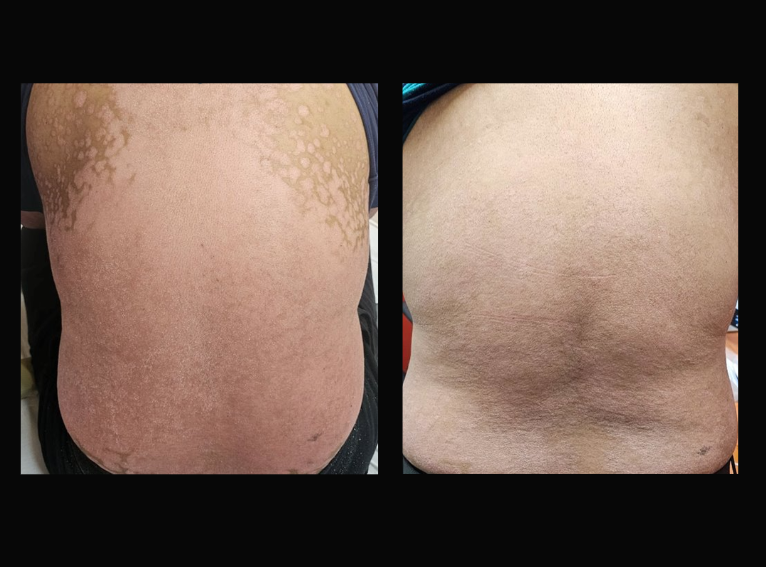
In February 2026, a young adult came to see us with psoriasis covering roughly 80% of the body. The knees, shoulders and heels hurt so much that walking had become a struggle. Four months later, after starting a biologic called tildrakizumab alongside other treatment, the skin was nearly clear.
We’re sharing this case, with the patient’s details anonymised, because many people with severe psoriasis in Kedah don’t realise biologic treatment for psoriasis is an option, or assume it’s out of reach. Below is what happened, why we chose this medicine, and what one case can and can’t tell you.
- Biologics are targeted injections for moderate-to-severe psoriasis when creams, phototherapy or standard tablets aren’t enough.
- In this case, skin involvement fell from about 80% to 30% within a month of starting tildrakizumab, and reached PASI 90 (nearly clear) by June 2026.
- Methotrexate, apremilast and a short course of prednisolone were used over the same period, so the result can’t be credited to tildrakizumab alone.
- Tildrakizumab is approved for plaque psoriasis. It is not approved for psoriatic arthritis.
- Tildrakizumab is registered in Malaysia (NPRA MAL24126016ACZ). Suitability and cost are discussed at consultation.
IN THIS ARTICLE
- When Psoriasis Affects More Than the Skin
- The Patient
- Why a Biologic Was Considered
- Why Tildrakizumab Was Chosen
- Treatment Timeline & Response
- What Is Tildrakizumab?
- Tildrakizumab & Psoriatic Arthritis
- Lessons From This Case
- Psoriasis Specialist in Kedah
- Conclusion
- Frequently Asked Questions
- References
1. When Severe Psoriasis Affects More Than the Skin
Most people think of psoriasis as a skin problem. For many of our patients it is much more than that. Widespread inflammation can bring pain, poor sleep, exhaustion and, in some people, damage to the joints.
Once the disease reaches this stage, moisturisers and steroid creams rarely keep it under control on their own. Most patients need systemic treatment, meaning tablets or injections that work throughout the body. Biologics are one group of these medicines. Our complete guide to psoriasis treatment walks through every option, from creams and phototherapy to tablets and biologics.
2. The Patient: Severe Psoriasis with Painful Joint Symptoms
The patient had lived with psoriasis since 2021 but hadn’t been under regular specialist follow-up. By February 2026 the skin had flared badly, covering an estimated 80% of the body surface area (BSA). The picture was in keeping with erythrodermic psoriasis, a severe form that needs prompt specialist care.
The joints were just as troublesome. There was plantar fasciitis (pain in the heel and sole), pain in both knees and in the shoulder, and the patient was relying on regular painkillers. Getting around was hard. We also noticed pitting of the nails, which is common when psoriasis involves the joints.
Blood tests showed raised inflammation markers (ESR 45, CRP 19). We arranged imaging and further tests for the joints, and brought in a rheumatologist early so that the skin and joints could be treated together.
3. Why Was a Biologic Treatment Considered?
Methotrexate and other conventional systemic medicines work well for many people with psoriasis. For this patient we wanted something more targeted, for several reasons:
- The skin inflammation was extensive and still active.
- Walking and everyday activities were badly affected.
- We needed control that would last, not just settle the flare for a few weeks.
- Cost, and how soon treatment could begin, mattered.
- The joint symptoms needed input from rheumatology as well.
The plan combined conventional systemic therapy with apremilast, and a biologic was added shortly afterwards.
4. Why Was Tildrakizumab Chosen for This Patient?
Tildrakizumab blocks interleukin-23 (IL-23), one of the main signals that keeps psoriasis inflammation going. Several biologics are available for psoriasis in Malaysia, and no single one is right for everybody.
For this patient, the decision came down to how quickly treatment could start and what was affordable. When we choose a biologic, we usually weigh up:
- The pattern and severity of the psoriasis.
- Whether there is confirmed psoriatic arthritis, or another cause for the joint pain.
- How fast the disease needs to be brought under control.
- Other health conditions, safety screening results and anything that rules a medicine out.
- Availability, cost and whether the patient can keep up with treatment long term.
5. Treatment Timeline and Clinical Response
Treatment was supervised and monitored by our team throughout, and more than one medicine was involved.
📏 BSA (body surface area) is simply how much of your skin has psoriasis. A quick way to picture it: the palm of your hand, fingers included, is about 1% of your skin. So 80% BSA means psoriasis covered most of the body. 30% is about a third.
📊 PASI is a score doctors use to measure how bad psoriasis is. It looks at how much skin is affected and how red, thick and scaly the patches are. The higher the score, the worse the psoriasis. PASI 90 means the psoriasis is at least 90% better than when treatment started. Think of it this way: if the psoriasis was a 10 out of 10 at the start, it is now 1 out of 10 or less.
~80% BSA, limited mobility
Tildrakizumab started
BSA 30%, walking without pain
Near-clear skin, PASI 90
February 2026: psoriasis on about 80% of the body, nail pitting, painful joints and limited mobility.
March 2026: first dose of tildrakizumab 100 mg, with the second (loading) dose about four weeks later. The other systemic medicines were continued.
April 2026: a big change. The patient could walk without pain, and skin involvement had come down to around 30%.
May 2026: prednisolone was tapered and stopped. Methotrexate and apremilast were also stopped, leaving tildrakizumab as the ongoing treatment.
June 2026: after the first two doses of tildrakizumab, the skin was nearly clear, with a PASI 90 response.
6. What Is Tildrakizumab and How Does It Work?
Tildrakizumab attaches to the p19 part of IL-23. IL-23 keeps a group of immune cells, called Th17 cells, switched on. These cells release chemicals that make skin cells multiply far too quickly and pile up into thick, scaly plaques. Blocking IL-23 calms the whole chain.
Older systemic medicines dampen the immune system more broadly. Biologics are more selective and aim at one specific step.
Tildrakizumab is injected under the skin. For plaque psoriasis, the usual schedule is 100 mg at week 0 and week 4, then every 12 weeks, in line with the local product information. Once the first two doses are done, that works out to roughly four injections a year.
100 mg
100 mg
100 mg
Before anyone starts a biologic, we screen for tuberculosis and other relevant infections, check vaccinations, and run any other tests their health history calls for.
7. Is Tildrakizumab Approved for Psoriatic Arthritis?
Psoriasis and psoriatic arthritis often go together, but clearing the skin doesn’t guarantee the joints are under control. That is why the approval status matters.
Tildrakizumab has been tested in psoriatic arthritis. In a phase IIb trial published in Annals of the Rheumatic Diseases in 2021, more patients on tildrakizumab reached an ACR20 response at week 24 than those on placebo, and several other joint and skin measures improved. Dactylitis (sausage-like swelling of a finger or toe) and enthesitis (inflammation where tendons attach to bone) did not improve, and some results were mixed.
A promising trial is not the same as approval. Our patient was walking without pain quite early on, which was encouraging, but other medicines were being used too. Joint symptoms deserve their own assessment by a rheumatologist.
8. What Does This Case Teach Us About Biologic Treatment for Psoriasis?
1. Don’t wait if psoriasis spreads quickly. Widespread red, painful skin, especially with fever, chills or feeling unwell, needs to be seen urgently.
2. Biologics are a realistic option. They are no longer kept for a small handful of patients. The right one depends on how severe your psoriasis is, what you’ve tried before, your other health conditions and your own preferences.
3. Tell your doctor about joint pain. Ongoing joint pain, swelling, heel pain or morning stiffness can be signs of psoriatic arthritis. Dermatologists and rheumatologists often work on this together.
4. Measure progress, don’t guess. BSA and PASI let us track how you’re doing objectively. How you feel, sleep and move matters just as much.
5. Cost and access are part of the decision. The best treatment on paper doesn’t help if it can’t be started or kept up. Availability, cost, monitoring and long-term use all count.
9. Where Can You Get Specialist Psoriasis Treatment in Kedah?
At Loh & Celine Skin Specialist Clinic in Alor Setar, we look at how severe your psoriasis is, what you’ve already tried, and whether advanced treatment such as phototherapy or a biologic makes sense for you. You can read more about how we manage severe psoriasis on our psoriasis treatment in Alor Setar page.
Dr Loh Ken Chen is a Consultant Dermatologist (NSR No. 133112) and former Head of Dermatology at Hospital Sultanah Bahiyah, Alor Setar, with a particular interest in psoriasis and other inflammatory skin diseases.
Which biologics are available, whether one suits you, and what it would cost are all things we go through with you at the consultation.
📍 18 Tingkat Bawah, Kompleks Perniagaan Gangsa, Jalan Gangsa, 05150 Alor Setar, Kedah, Malaysia
📞 Telephone: 04-731 5711
💬 WhatsApp: 016-291 5711
🌐 www.lohcelineskinspecialist.com
10. Conclusion
Our patient went from extensive psoriasis and painful, limited walking to nearly clear skin and PASI 90 in about four months, on a combination of treatments that included tildrakizumab.
Tildrakizumab is an established option for adults with moderate-to-severe plaque psoriasis. It is not approved for psoriatic arthritis, even though the research so far is encouraging.
If you’re living with severe psoriasis, or with joint pain alongside your skin, a specialist review is the first step towards a treatment plan that is safe and realistic for you.
Living with Severe Psoriasis?
Book a consultation with our psoriasis specialist in Alor Setar to talk through your options, including whether a biologic is suitable for you.
Book a Consultation WhatsApp 016-291 571111. Frequently Asked Questions
What is biologic treatment for psoriasis?
What is tildrakizumab?
Can tildrakizumab achieve PASI 90?
Is tildrakizumab approved for psoriatic arthritis?
Is tildrakizumab available in Malaysia?
How much does biologic treatment for psoriasis cost in Malaysia?
When should someone with psoriasis see a dermatologist?
12. References
- Mease PJ, et al. Efficacy and safety of tildrakizumab in patients with active psoriatic arthritis: results of a randomised, double-blind, placebo-controlled, multiple-dose, 52-week phase IIb study. Annals of the Rheumatic Diseases. 2021. PubMed
- US Food and Drug Administration. Tildrakizumab-asmn Prescribing Information. FDA label (PDF)
- National Pharmaceutical Regulatory Agency (NPRA), Malaysia. QUEST3+ product registration database: tildrakizumab 100 mg/mL solution for injection (prefilled syringe), MAL24126016ACZ. QUEST3+

Dr Loh Ken Chen
M.B.B.S. (Malaya), MRCP (UK), Advanced Master of Dermatology (UKM)
National Specialist Register (NSR) No. 133112
Dr Loh Ken Chen is a Consultant Dermatologist with extensive experience in medical and aesthetic dermatology. He previously served as Head of the Department of Dermatology at Hospital Sultanah Bahiyah, Alor Setar, and has clinical interests in psoriasis, eczema, acne, pigmentation and complex skin conditions. His approach focuses on accurate diagnosis, evidence-based treatment, and care tailored to each patient’s skin condition and needs.
Practises at: Kedah Medical Centre, Hospital Pantai Sungai Petani & Liv Skin Specialist Clinic.
Medical disclaimer: This is an anonymised case report for educational purposes. Results vary between patients, and this article does not replace a personal medical consultation. Treatment decisions should be made with a qualified healthcare professional.