
Dermatology Guide
Hormonal Acne in Malaysia: Causes, Signs & Treatment Including Winlevi (Clascoterone)
Hormonal acne is one of the most common skin concerns among teenagers and adult women in Malaysia, and it often appears on the lower face — the chin and jawline. If you are an adult woman still struggling with acne around the chin and jaw — breakouts that return every month before your period and don’t settle even after trying many products — you are not alone. This pattern is often called hormonal acne, and it is one of the most common reasons adult patients come to see a dermatologist. In this guide, a dermatologist explains hormonal acne and Winlevi (clascoterone) in Malaysia — how it works, who it suits, side effects, cost, and where to get it.
In this guide I want to explain what “hormonal acne” actually means, why it happens, and how it is treated — including a newer topical option, Winlevi (clascoterone). My goal is not to promote any particular medicine, but to give you accurate, balanced, evidence-based information so you can make a sensible decision about your skin.
What Is Hormonal Acne?
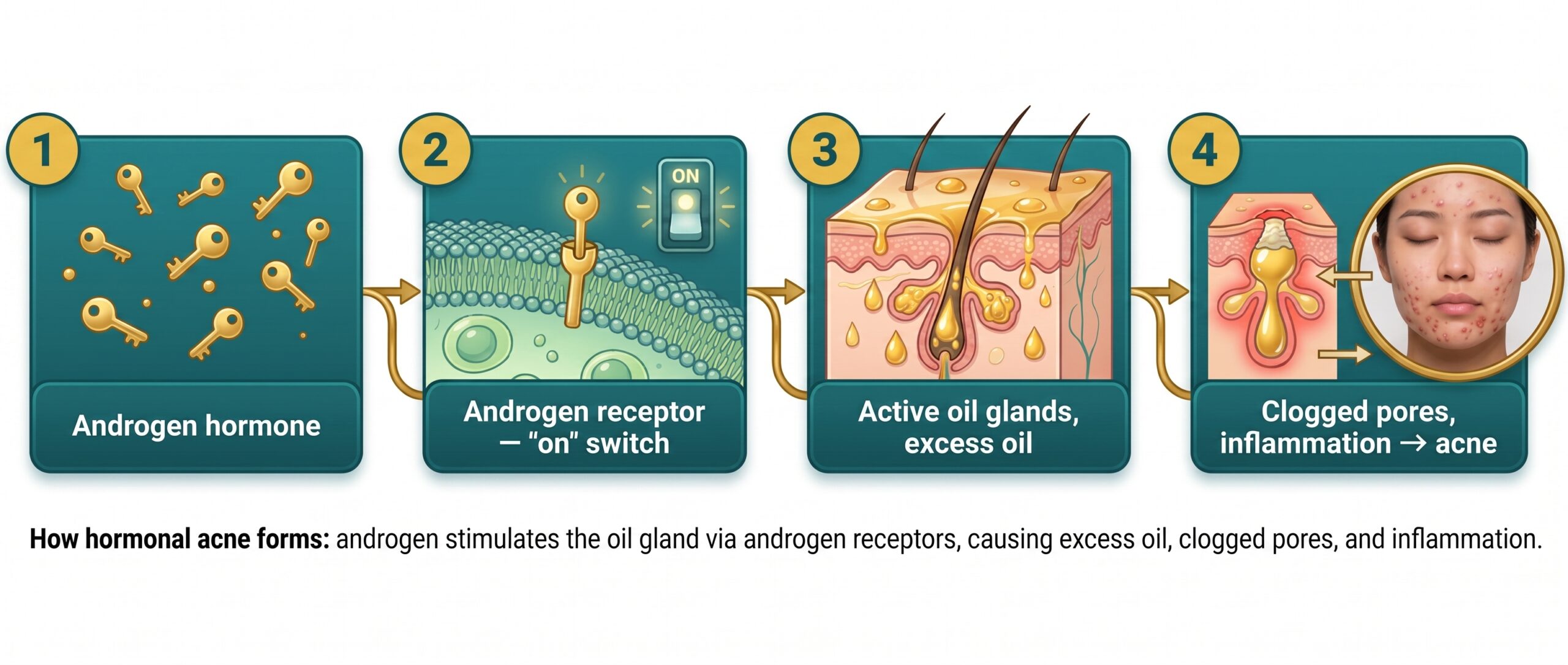
Hormonal acne is acne that develops when androgen hormones over-stimulate the skin’s oil glands. It is not a separate type of acne, but a way of describing acne in which androgen signalling plays an important role.
Androgens are a group of hormones (including testosterone) present in both men and women. One of their jobs is to regulate the skin’s oil (sebum) glands. When these glands become overactive, the skin produces excess oil, pores clog, bacteria multiply and inflammation follows — and the result is acne.
One important point to understand: hormonal acne does not necessarily mean your blood hormone levels are high. Many patients actually have normal hormone levels, but their pilosebaceous unit — the combination of hair follicle and oil gland — is more sensitive to androgen signals. So the problem is not always “too much hormone”, but sometimes “skin that is too sensitive” to the hormones that are present.
Does Jawline Acne Always Mean Hormonal Acne?
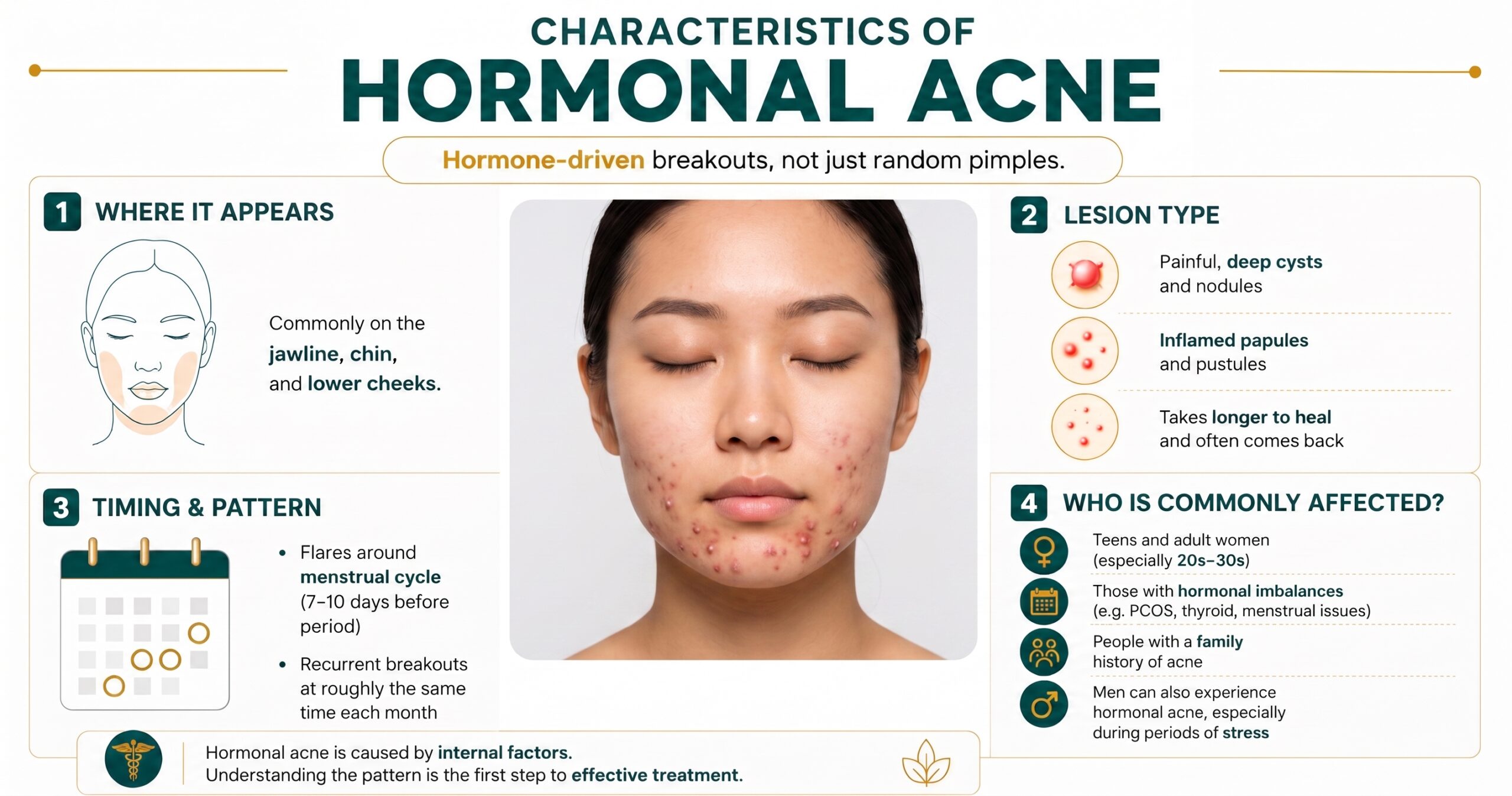
No. Acne on the jaw and chin is often linked to hormonal influence, but location alone is not enough to confirm that someone has hormonal acne.
Breakouts on the lower face — chin, jaw and neck — are indeed seen more often in androgen-influenced acne, especially in adult women. But the same areas can also be affected by acne from other causes, such as friction or pressure on the skin (for example a helmet strap or touching the face), pore-clogging cosmetic products, or other conditions that mimic ordinary acne.
That is why I always advise patients not to “self-diagnose” hormonal acne based on location alone. An accurate diagnosis requires an overall assessment, not just looking at where the acne appears.
How Do Hormones Cause Acne?
Androgens cause acne by stimulating the oil glands to produce more sebum, which then clogs pores and triggers inflammation.
The process can be understood in a few simple steps. Androgens send signals to the oil glands through androgen receptors in the skin. Think of the androgen as a signal, and the androgen receptor as a switch that receives it. When this switch is “turned on”, the oil gland enlarges and produces more sebum.
Excess sebum mixes with dead skin cells, causing the pore to clog (follicular plugging). This blocked environment suits the skin bacterium Cutibacterium acnes, which then multiplies. The body reacts to the blockage and bacteria with inflammation — which is why pimples become red, swollen and sometimes painful.
The four main factors in acne
In short, most acne involves a combination of four things: excess oil production (influenced by androgens), clogged pores, C. acnes bacteria, and inflammation. Effective treatment usually targets more than one of these factors.
What Are the Signs of Hormonal Acne?
Although no single sign can confirm hormonal acne on its own, there are several patterns often seen when hormones play an important role:
- Acne concentrated on the lower face — chin, jaw and sometimes the neck.
- Acne that worsens before the period (premenstrual flares).
- Persistent or frequently recurring acne in adult women (adult female acne), even beyond the teenage years.
- Deep, inflamed and sometimes painful breakouts, rather than just blackheads or whiteheads.
- Acne that doesn’t settle despite trying various standard treatments.
It must be stressed again: these patterns are clues, not definitive proof. Men can also experience androgen-influenced acne, though the “premenstrual” pattern obviously does not apply to men. A specialist assessment is needed to distinguish hormonal acne from other causes.
Dr Loh Ken Chen — Clinical Perspective
Even at 40 you can still break out — this is something I see almost every day in clinic. Many patients are surprised, because they think acne is only a teenage problem.
In my experience, hormonal acne often needs combination treatment — for example a retinoid together with Winlevi — because each medicine targets a different mechanism of acne. I also advise patients on lifestyle and appropriate skincare, because these matter as much as medication.
That is why every patient needs a different approach. My goal is not just to clear the acne of today, but to control inflammation early to reduce the risk of scarring in the future.
What Is Winlevi?
Winlevi is the brand name for clascoterone 1% cream — a topical androgen receptor inhibitor approved to treat acne vulgaris. It is applied directly to the skin and acts on the androgen receptors in that area of skin itself.
Clascoterone was approved by the U.S. FDA in 2020 for the treatment of acne vulgaris in patients aged 12 and above. It drew attention in the dermatology world because it was the first topical treatment to target the androgen receptor directly — a mechanism different from most existing topical acne medicines. Official product information can be found on the official Winlevi website.
Here an honest clarification matters: Winlevi is approved for acne vulgaris, not specifically for a diagnosis called “hormonal acne”. “Hormonal acne” is a clinical term commonly used to describe acne in which androgen signalling may play an important role. Because clascoterone acts on the androgen pathway in the skin, it may be a relevant option for some patients with androgen-influenced acne features — but this needs to be assessed individually, not assumed.
How Does Winlevi Work?
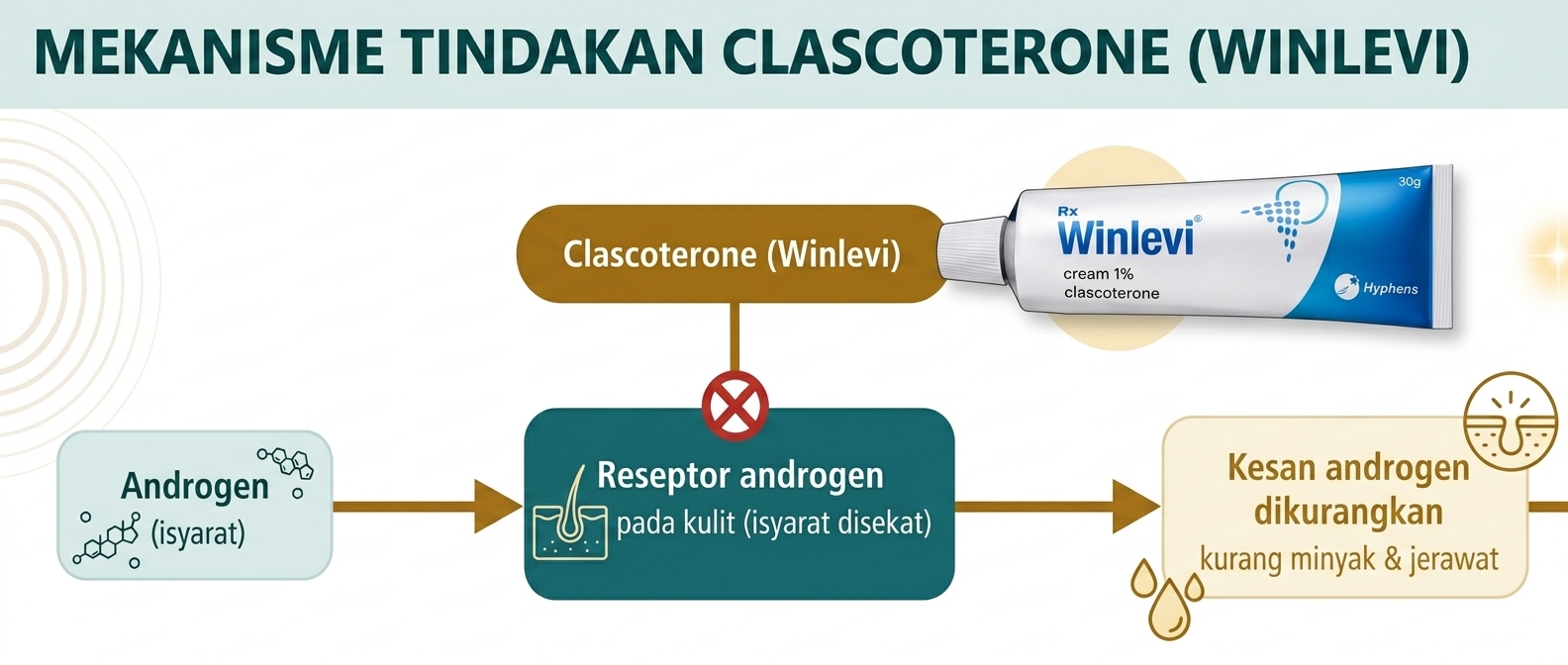
Winlevi works by blocking androgen signalling at the androgen receptors in the skin, thereby reducing the effect of androgens on the oil glands.
Remember the switch analogy? Androgen is the signal, and the androgen receptor is the switch that receives it to stimulate the oil gland. Clascoterone acts like something that blocks the signal from “pressing the switch” in the skin. In short, the pathway is as follows:
- Androgen → androgen receptor → signal to the oil gland / acne.
- Clascoterone → blocks the signal at the androgen receptor → reduces the androgen-driven effects on the skin (such as excess oil production and the related inflammation).
Because it is applied to the skin and acts locally, the systemic exposure of clascoterone is generally lower than oral anti-androgen therapy. However, this does not mean it has no effect on the body at all — we’ll discuss safety in more detail below.
What Do the Clinical Studies Say About Winlevi?
Two large Phase 3 clinical studies showed clascoterone 1% to be more effective than placebo (vehicle) cream in reducing acne at week 12, with a generally good safety profile.
Clascoterone was evaluated in two similar randomised Phase 3 studies involving a total of about 1,440 patients with moderate to severe facial acne. “Treatment success” was defined as skin becoming clear or almost clear (IGA score of 0 or 1) with an improvement of at least 2 grades at week 12.
Summary of Phase 3 results (week 12)
Treatment success rates (IGA):
- First study: 18.4% (clascoterone) vs 9.0% (placebo)
- Second study: 20.3% (clascoterone) vs 6.5% (placebo)
Both studies also showed greater reductions in the number of inflammatory and non-inflammatory lesions compared with placebo. All these differences were statistically significant (P < .001).
On safety, the rate of side effects in these studies was low and mostly mild; the most common local skin reaction was mild redness. This data comes from studies published in peer-reviewed dermatology journals and the official prescribing information — not from marketing claims. As with all treatments, however, study figures represent averages across a group of patients, not a guarantee of results for any individual.
Winlevi vs Other Acne Treatments
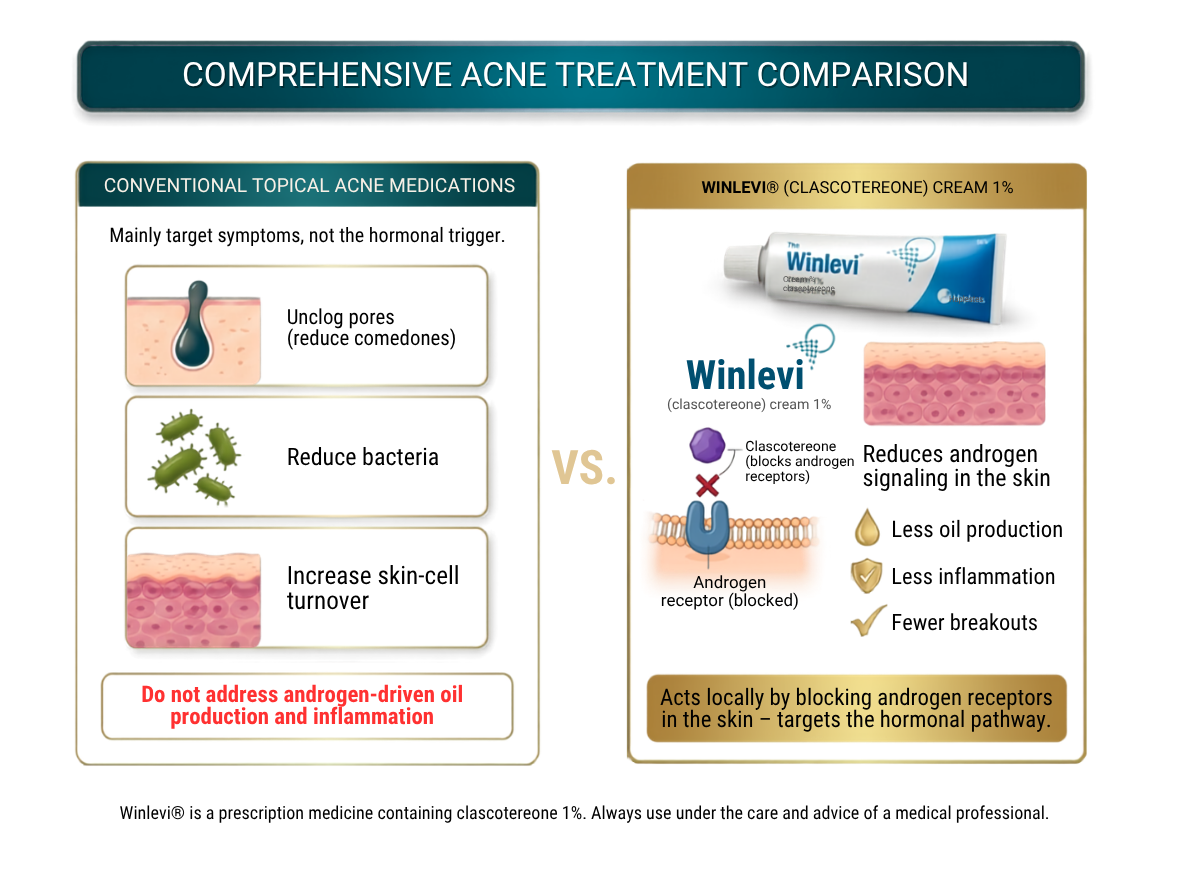
A common question is: “Is Winlevi better than other treatments?” The answer isn’t simple, because each treatment targets a different acne mechanism. Here is a brief comparison.
| Treatment | Type | Mechanism | Key note |
|---|---|---|---|
| Winlevi (clascoterone 1%) | Topical | Blocks androgen receptors in the skin | Approved for acne vulgaris; targets the androgen pathway; systemic exposure generally lower |
| Retinoids (e.g. tretinoin, adapalene) | Topical | Normalise follicular cell turnover, reduce comedones, anti-inflammatory | Different mechanism — potentially complementary to Winlevi |
| Spironolactone | Oral (systemic) | Systemic anti-androgen therapy | For selected patients; needs medical consideration & monitoring |
| Benzoyl peroxide | Topical | Reduces C. acnes bacteria & pore blockage | Often used as part of combination treatment |
Each treatment targets a different acne mechanism. The best choice depends on the individual — not necessarily the “strongest” medicine.
Winlevi vs Retinoids
Retinoids (such as tretinoin or adapalene) and clascoterone work through different mechanisms. Retinoids help normalise the cell-turnover process in the follicle (follicular keratinisation), reduce comedones, and have anti-inflammatory effects. Clascoterone targets androgen receptor signalling. Because their mechanisms differ, the two may complement each other in some cases. Neither can be called absolutely better for all patients.
Winlevi vs Spironolactone
Winlevi is a topical treatment that acts on the androgen receptors in the skin and generally has lower systemic exposure than oral anti-androgen therapy. Spironolactone is an oral (systemic) medicine with a different mechanism that requires thorough clinical consideration. Important to understand: this does not mean Winlevi is “safer” for every patient. The choice between topical and oral treatment depends on the individual, acne severity and other medical considerations.
Winlevi vs Benzoyl Peroxide
Benzoyl peroxide targets a different aspect of acne — mainly C. acnes bacteria and blockage — and is often used as part of combination acne treatment. It is not a competitor to clascoterone, but rather a complementary partner in a comprehensive treatment plan.
An important principle
The best acne treatment is not necessarily the “strongest” medicine. It is the treatment that targets the most dominant acne mechanism in that patient, while balancing effectiveness, skin comfort, and long-term adherence.
How Is Hormonal Acne Treated?
Hormonal acne is treated according to each patient’s situation — there is no single treatment that suits everyone. The treatment plan depends on severity, acne type, scarring risk, age, pregnancy considerations, other hormonal symptoms, response to previous treatments, and patient preference.
Treatment options that may be considered include topical retinoids, benzoyl peroxide, topical antibiotics in certain situations, clascoterone, oral antibiotics for selected cases, hormonal therapy for suitable female patients, and isotretinoin for severe or refractory acne. In many situations, a combination of treatments targeting different mechanisms gives better results than a single medicine alone.
Within this framework, Winlevi is best understood as an additional mechanism-based treatment option — another way to target the androgen pathway in the skin — and not as automatically the best or only treatment. You can read more about our approach to acne treatment on our acne treatment page.
When Are Hormone Tests Needed?
Routine hormone testing is not needed for every acne patient. Most acne patients, including those with “hormonal acne” features, can be treated well without hormone blood tests.
Further evaluation, including hormone tests, may be appropriate when acne is accompanied by other signs of androgen excess or an endocrine problem, such as:
- Irregular periods.
- Excessive hair growth in a male pattern (hirsutism).
- Thinning of scalp hair.
- Acne that appears suddenly or worsens abruptly.
- Other signs of androgen excess.
- Suspicion of polycystic ovary syndrome (PCOS) or other endocrine symptoms.
It must be emphasised: acne alone cannot be used to diagnose PCOS or any hormonal disorder. The decision to do hormone testing is based on the overall clinical picture, not simply because someone has acne.
Who Might Be Suitable for Winlevi?
Winlevi may suit some patients with acne vulgaris — especially those who need an additional topical treatment mechanism — but suitability must be assessed individually by a doctor.
Patients who may be relevant to consider include those with acne vulgaris, persistent acne, acne with possible androgen influence, an unsatisfactory response to current topical treatments, or those who need a different topical treatment mechanism. Some patients also prefer a topical treatment over oral medication.
Nevertheless, just because someone has “hormonal acne” features does not mean Winlevi is automatically suitable for them. Considerations such as pregnancy or pregnancy planning, current skin condition, and other treatments in use all need to be assessed first.
Where to Get Winlevi in Malaysia
Winlevi (clascoterone 1%) is a prescription medicine in Malaysia. It is not sold over the counter at pharmacies or online without a doctor’s prescription. To get Winlevi, you need to be assessed by a dermatologist or doctor who can prescribe it if it is suitable for your skin.
Winlevi has been officially introduced in Malaysia and is available by prescription. Because it is a prescription medicine, the first step is not simply “buying” Winlevi — it is getting a proper skin assessment so the treatment prescribed genuinely fits your type of acne.
At Loh & Celine Skin Specialist Clinic, Dr Loh Ken Chen (Consultant Dermatologist) assesses whether your acne is androgen-influenced and whether Winlevi — on its own or as part of a combination plan — is a suitable option for you. Dr Loh also practises at Kedah Medical Centre (Alor Setar), Hospital Pantai Sungai Petani, and Liv Skin Specialist Clinic.
How to get Winlevi (quick steps)
- Book an appointment with a dermatologist for an acne assessment.
- Your skin is evaluated to determine whether hormonal/androgen influence is involved.
- If appropriate, Winlevi is prescribed (with or without additional treatment) along with usage instructions.
- Follow-up is arranged to monitor response and safety.
Winlevi’s price varies and depends on the clinic and your treatment plan. As a prescription medicine, cost is usually discussed during consultation alongside a full treatment plan.
How Is Winlevi Used?
In general, according to the prescribing information, clascoterone 1% is applied as a thin layer to the affected area twice a day — morning and evening. It is for external use on the skin only, and should be kept away from the eyes and mucous membranes (such as the inside of the nose or mouth).
Most importantly: the actual way it is used must follow the instructions of the prescribing doctor. The doctor may adjust how it is used based on your skin condition and response. Do not increase the frequency or amount on your own hoping for faster results — this can cause more irritation without added benefit.
What Are the Side Effects of Winlevi?
The most common side effects of Winlevi are mild local skin reactions, such as redness, dryness and irritation. Winlevi is a prescription medicine, not an ordinary skincare product, so it should be used under a doctor’s supervision.
Possible local side effects include redness, dryness, peeling, itching, stinging or burning, and skin irritation. In clinical studies, most of these local reactions were found to be mild.
Systemic safety considerations
The prescribing information also mentions some systemic safety considerations. Among them, HPA (hypothalamic-pituitary-adrenal) axis suppression can occur — in studies, this was seen in a small number of subjects and recovered after treatment was stopped. Changes in potassium levels (hyperkalaemia) have also been observed in a few subjects. This is why Winlevi is used under medical supervision.
I share this information not to frighten you, but to give an honest and balanced picture. Winlevi is not “100% safe with no risk at all” — no medicine is. Rather, for most suitable patients, it is a treatment that is generally well tolerated when used correctly under a doctor’s advice.
How Long Does Winlevi Take to Work?
Acne treatment does not work overnight. In the Phase 3 studies, the main results were assessed at about 12 weeks, so you need to give it time and use the treatment consistently.
Like most acne treatments, improvement happens gradually. Consistency is key — using the treatment continuously as directed matters more than expecting dramatic changes in a few days. Remember too that the goal of acne treatment is not only to clear existing acne, but also to prevent new breakouts and reduce the risk of scarring. I cannot promise a specific result for any individual, because every skin responds differently.
Acne in the Context of Malaysia’s Climate
Malaysia’s hot and humid climate poses its own challenges for acne patients. Excessive sweating, pore-clogging (occlusive) skincare or makeup, and exposure to hot weather can make acne harder to control. Choosing acne-friendly (non-comedogenic) skincare and sunscreen can help.
One thing that often worries patients in Malaysia is the dark marks left after acne heals (post-inflammatory hyperpigmentation). This is why controlling acne inflammation as early as possible is important — the longer and more severe the inflammation, the higher the risk of dark marks and scars that take a long time to fade. You can read more about acne treatment and acne scars and pigmentation on our website.
Conclusion
“Hormonal acne” is a useful way to describe acne in which androgen signalling plays an important role — but it is not something that can be confirmed by acne location alone, and it does not necessarily mean your hormone levels are high. Accurate diagnosis and treatment require a thorough assessment by a specialist.
Winlevi (clascoterone) is an interesting addition to the acne treatment toolkit because it targets the androgen receptor in the skin topically — a mechanism different from retinoids, benzoyl peroxide or spironolactone. It is a relevant option for some patients, but not a magic solution for everyone. The best treatment is always the one tailored to your acne mechanism, skin condition and individual needs.
Frequently Asked Questions
What is hormonal acne?
Acne that develops when androgen hormones over-stimulate the skin’s oil glands. It’s not a separate acne type, but a description of acne where androgen signalling plays a key role. It doesn’t necessarily mean your blood hormone levels are high — often the skin is simply more sensitive to normal androgen levels.
Does jawline acne always mean hormonal acne?
No. Chin and jaw acne is often linked to hormonal influence, but location alone can’t confirm it — friction, pore-clogging products and other conditions can affect the same area. A proper assessment is needed.
What are the signs of hormonal acne in women?
Common patterns include breakouts on the lower face (chin/jaw), flares before the period, persistent adult acne, and deep inflamed lesions that don’t settle with standard products. These are clues, not proof.
Can men get hormonal acne?
Yes. Men can have androgen-influenced acne too, although the premenstrual-flare pattern obviously doesn’t apply. Assessment by a specialist is still needed to confirm the cause.
What is Winlevi?
Winlevi is the brand name for clascoterone 1% cream, a topical androgen receptor inhibitor approved for acne vulgaris. It’s the first topical treatment to target the androgen receptor in the skin directly.
How does Winlevi work?
It blocks androgen signalling at the androgen receptors in the skin, reducing the androgen-driven effects on the oil glands — such as excess oil and related inflammation. Because it acts locally, systemic exposure is generally lower than oral anti-androgens.
Is Winlevi the same as spironolactone?
No. Winlevi is a topical acting on skin androgen receptors with generally lower systemic exposure; spironolactone is an oral systemic anti-androgen. This doesn’t make Winlevi “safer” for everyone — the choice depends on the individual.
Is Winlevi the same as tretinoin (a retinoid)?
No. Retinoids normalise follicular cell turnover and reduce comedones; clascoterone targets androgen receptor signalling. Because the mechanisms differ, they can complement each other in some cases.
How long does Winlevi take to work?
Improvement is gradual. In Phase 3 studies the main results were assessed at about 12 weeks, so consistent use over time is important — dramatic results in a few days shouldn’t be expected.
What are the side effects of Winlevi?
Most commonly mild local reactions — redness, dryness, peeling, itching, stinging or irritation. The prescribing information also notes systemic considerations (HPA-axis suppression and potassium changes in a small number of subjects), which is why it’s used under medical supervision.
Do I need hormone tests for acne?
Not routinely. Most acne, including “hormonal acne”, is treated without hormone blood tests. Testing is considered when there are other signs of androgen excess (e.g. irregular periods, hirsutism, sudden severe acne) or suspicion of PCOS.
Who is suitable for Winlevi?
Some patients with acne vulgaris — especially those needing an additional topical mechanism, with persistent acne, possible androgen influence, or an inadequate response to current topicals. Suitability, including pregnancy considerations, must be assessed individually.
Is Winlevi available in Malaysia?
Yes. Winlevi (clascoterone 1%) has been officially introduced in Malaysia and is available by doctor’s prescription.
Where can I buy or get Winlevi in Malaysia?
Winlevi is a prescription medicine and cannot be bought over the counter without a prescription. You obtain it after assessment by a dermatologist who can prescribe it if suitable — for example at Loh & Celine Skin Specialist Clinic.
Can I buy Winlevi without a prescription?
No. Winlevi (clascoterone) is a prescription medicine in Malaysia and must be prescribed and used under a doctor’s supervision. Pharmacies should not dispense it without a valid prescription. To get an assessment and a prescription, you can see a Dermatologist in Malaysia or arrange a consultation with Dr Loh Ken Chen at Loh & Celine Skin Specialist Clinic.
Which clinic prescribes Winlevi in Kedah / northern Malaysia?
Dr Loh Ken Chen, Consultant Dermatologist, assesses and prescribes acne treatment including Winlevi at Loh & Celine Skin Specialist Clinic, and also practises at Kedah Medical Centre (Alor Setar), Hospital Pantai Sungai Petani, and Liv Skin Specialist Clinic.
Can Winlevi replace isotretinoin?
No. Isotretinoin is an oral treatment usually reserved for severe or refractory acne; Winlevi is a topical with a different role. They are not direct substitutes — the right choice depends on acne severity and individual assessment.
How much does Winlevi cost in Malaysia?
The price varies by clinic and treatment plan. As a prescription medicine, the cost is usually discussed during consultation alongside your overall treatment plan.
Can Winlevi be used during pregnancy?
This must be decided with your doctor. As with most acne medicines, suitability during pregnancy or when planning pregnancy needs individual assessment — do not start it in this situation without medical advice.
Recurring Acne on Your Chin and Jaw?
If your acne keeps appearing around the chin and jaw, worsens before your period, or persists despite trying many acne products, a dermatologist can help determine whether hormonal influence is truly involved — and which treatment approach suits you best.
You are welcome to discuss with Dr Loh Ken Chen at Loh & Celine Skin Specialist Clinic for a thorough assessment and a tailored treatment plan.
📍 Loh & Celine Skin Specialist Clinic — 18, Tingkat Bawah, Kompleks Perniagaan Gangsa, Jalan Gangsa, 05150, Alor Setar, Kedah
📞 016-2915711 | 💬 WhatsApp to book

Further reading & references
- Acne — causes and treatment (Mayo Clinic)
- Clinical evidence for clascoterone (Journal of the American Academy of Dermatology)
- Acne patient information (European Academy of Dermatology and Venereology (EADV))
- Official product website (Winlevi® (clascoterone))
- Related article — Winlevi for hormonal acne in Malaysia (Liv Skin Specialist Clinic)
Medical Disclaimer: This article is intended for general educational purposes only and does not constitute medical advice, diagnosis or treatment. It is not a substitute for a professional consultation. Individual results and treatment suitability vary. Please consult a qualified dermatologist or doctor regarding your specific condition before starting, changing or stopping any treatment.